How Many Perler Beads Do You Need? Pegboard Math
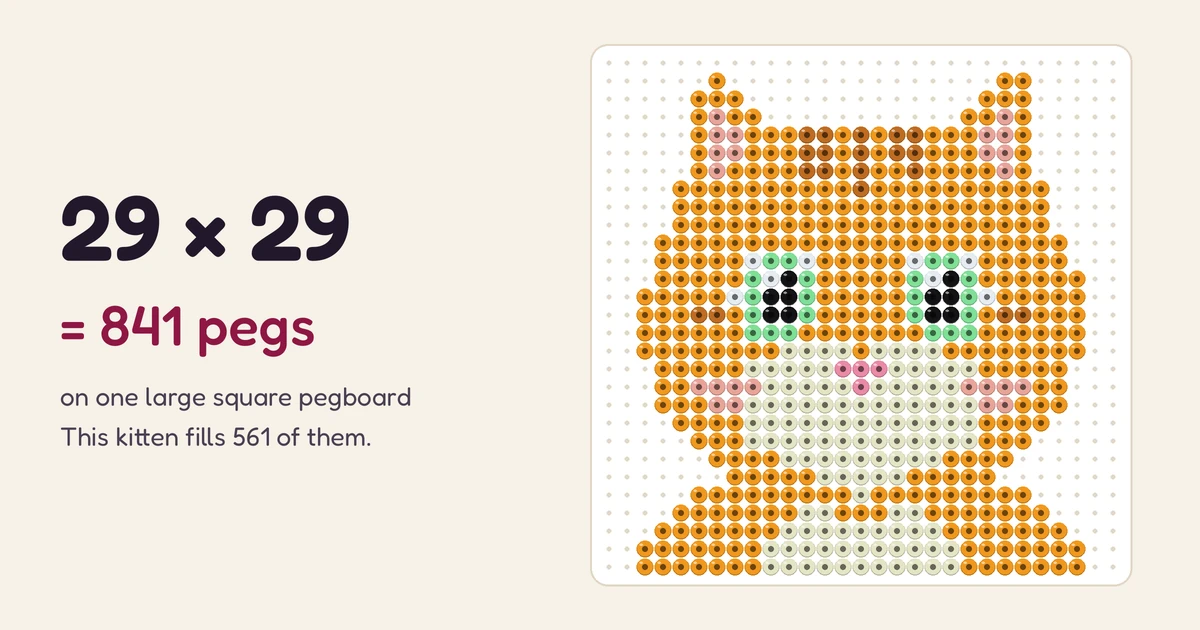
How many Perler beads do I need? The honest answer is "fewer than the pegboard holds". A large square pegboard has 841 pegs, but most designs leave the background empty, so you need beads only for the filled squares. This guide gives you the numbers for every common board, the finished size in centimeters and inches, and a simple way to count each color so you buy enough without a drawer full of leftovers.
Beads per pegboard
To find the capacity of any square board, count the pegs along one edge and multiply that number by itself. Here are the common large square boards:
| Pegboard | Bead size | Pegs per side | Total pegs | Width |
|---|---|---|---|---|
| Perler or Hama large square (standard/midi) | 5 mm | 29 | 841 | about 14.5 cm / 5.7 in |
| Hama Mini large square | 2.5 mm | 57 | 3,249 | about 14.3 cm / 5.6 in |
| 2.6 mm mini board (common with MARD) | 2.6 mm | 52 | 2,704 | about 13.5 cm / 5.3 in |
| Hama Maxi large square | 10 mm | 16 | 256 | about 16 cm / 6.3 in |
Perler's large mini pegboards measure 5.875 in (about 14.9 cm) per side, but Perler doesn't list their peg count, so count yours. Shaped boards (circles, hexagons, hearts) hold fewer beads than a square of the same width.
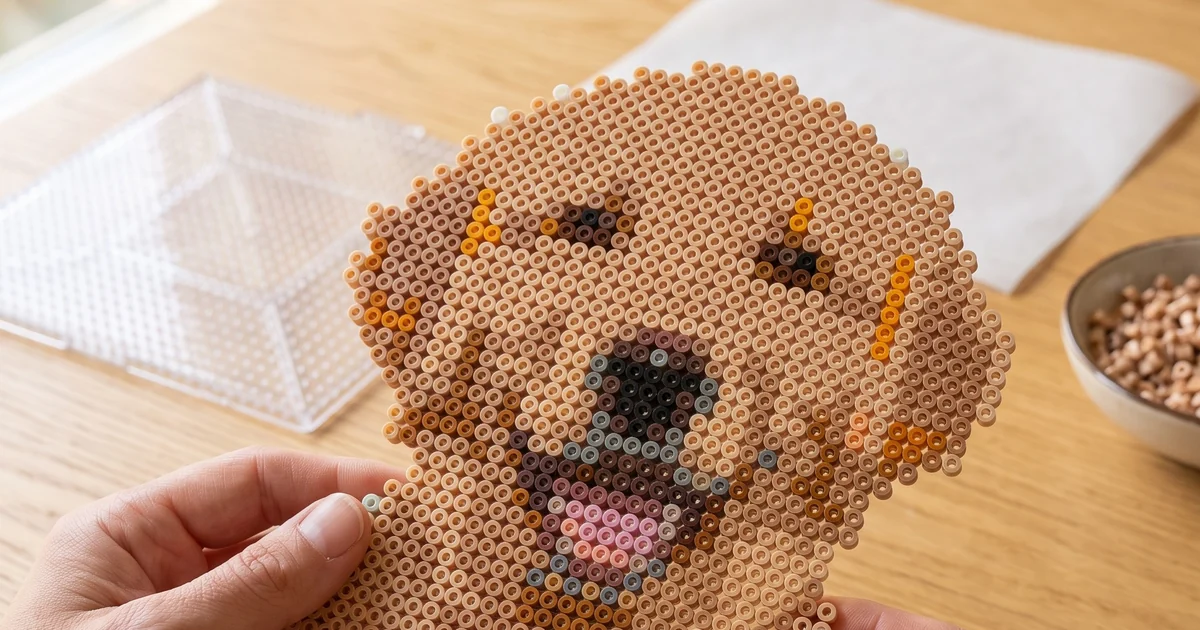
A full board is rare. The kitten on this page fills 561 of its 841 pegs, about two thirds. A simple one-board dog portrait made in BeadPop used 337 beads, about 40% of the board.
Finished size in inches and cm
The finished width is the number of beads across multiplied by the bead size. Standard beads are 5 mm; minis are about 2.6 mm (Hama minis are 2.5 mm).
| Beads across | Standard 5 mm | Mini 2.6 mm | Biggie/Maxi 10 mm |
|---|---|---|---|
| 29 (1 board wide) | 14.5 cm / 5.7 in | 7.5 cm / 3.0 in | 29 cm / 11.4 in |
| 52 | 26 cm / 10.2 in | 13.5 cm / 5.3 in | 52 cm / 20.5 in |
| 58 (2 boards wide) | 29 cm / 11.4 in | 15.1 cm / 5.9 in | 58 cm / 22.8 in |
| 87 (3 boards wide) | 43.5 cm / 17.1 in | 22.6 cm / 8.9 in | 87 cm / 34.3 in |
Two practical notes. Ironing pulls a piece in slightly, more if you melt it flat, so measure the finished piece before buying a frame. And the same pattern built in minis comes out about half as wide, which is the easiest way to shrink a design without changing it.
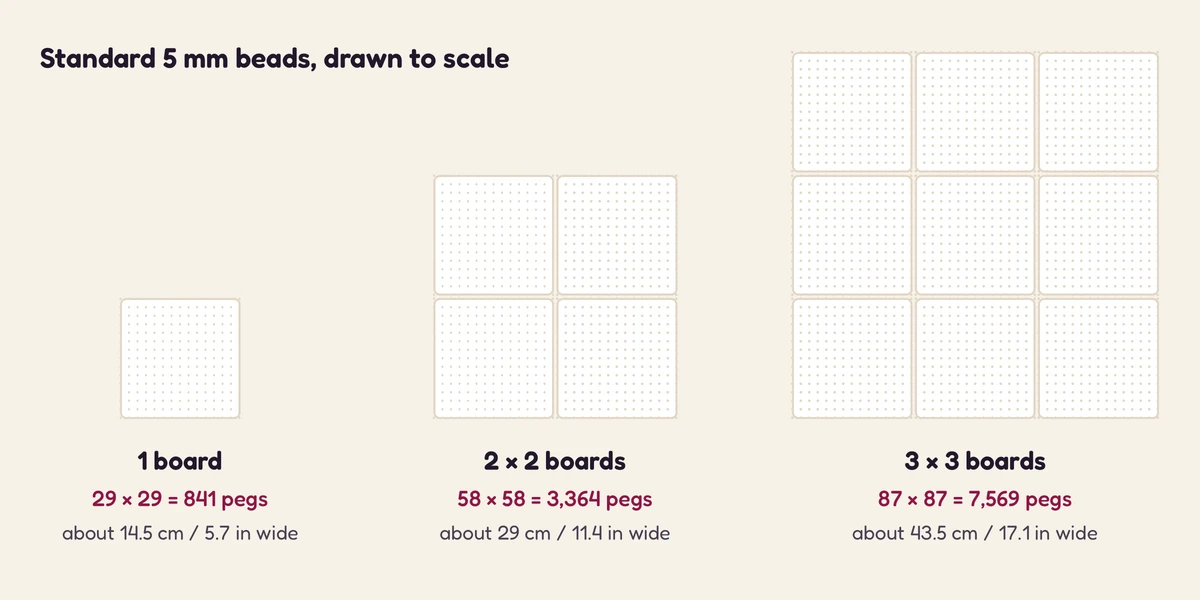
Multi-board projects: 2×2 = 3,364 beads, 3×3 = 7,569 beads
Large square pegboards clip together side by side:
- One board: 29 × 29 = 841 pegs, about 14.5 cm wide.
- 2 × 2 boards: 58 × 58 = 3,364 pegs, about 29 cm wide.
- 3 × 3 boards: 87 × 87 = 7,569 pegs, about 43.5 cm wide.
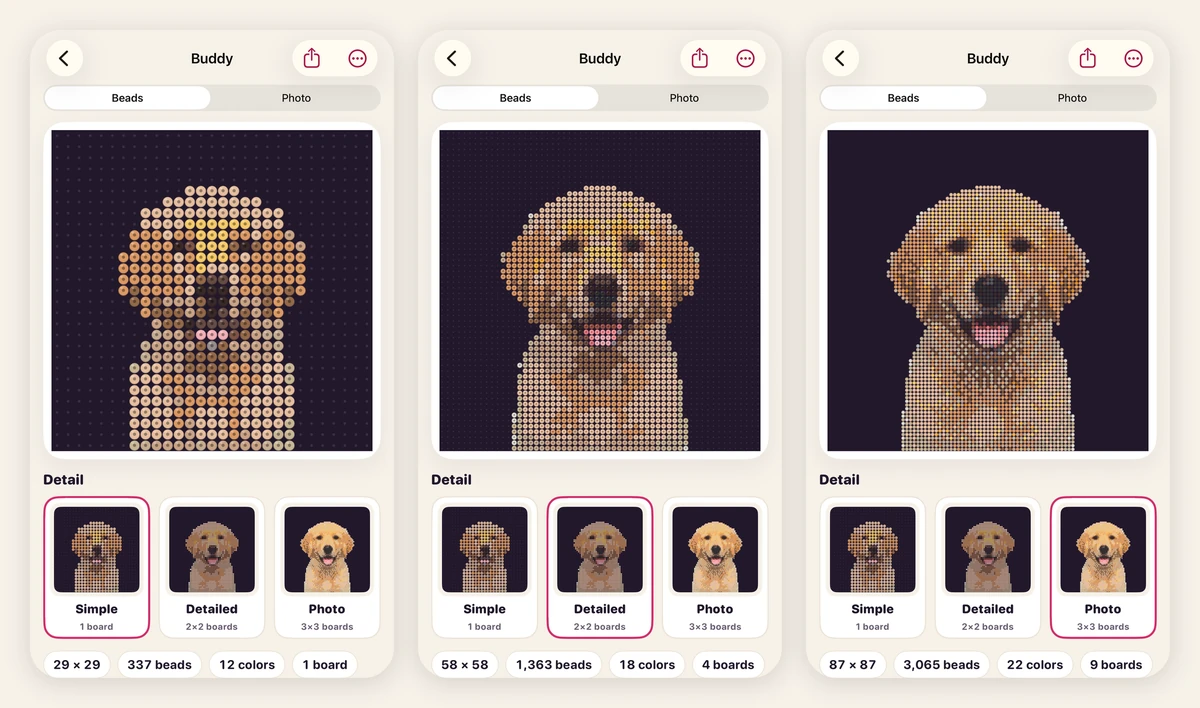
The jump from 841 to 7,569 pegs looks scary, but portraits rarely fill the corners. Here is the same golden retriever photo turned into a pattern at three sizes in BeadPop, with Perler colors:
- Simple, 1 board: 337 beads in 12 colors.
- Detailed, 2 × 2 boards: 1,363 beads in 18 colors.
- Photo, 3 × 3 boards: 3,065 beads in 22 colors.
In each case the dog covers about 40% of the pegs. That's a fair first guess for any pet portrait with an empty background.
How many Perler beads do you need of each color?
The total tells you how long the project takes. The count per color tells you what to buy.
Counting from the pattern
- List every color in the pattern, with its code.
- Go row by row and tally each color on paper, or mark the squares off with a highlighter as you count.
- Add up each color and check that the colors sum to the total number of filled squares.
Here is the tally for the kitten on this page. It is a one-board design in Hama Midi colors, but the math is identical for Perler.
| Color | Beads in pattern | With 10% extra |
|---|---|---|
| H60 Teddybear Brown | 357 | 393 |
| H02 Cream | 117 | 129 |
| H26 Matt Rose | 24 | 27 |
| H47 Pastel Green | 22 | 25 |
| H21 Light Brown | 19 | 21 |
| H18 Black | 10 | 11 |
| H01 White | 8 | 9 |
| H06 Pink | 4 | 5 |
| Total | 561 | 620 |
Adding a margin for lost and odd beads
Beads roll off the table, some come out of the bag misshapen, and you will change your mind about a few squares. A 10% margin, rounded up, covers most of that. For colors you need only a handful of, keep a few spares anyway. Making the same small piece for a whole class? Our Perler bead party favors guide runs the numbers for 25 guests.
Buy all of one color from the same batch if you can. Dye lots vary a little, and two bags of the "same" color side by side in one patch of fur can show.
How many beads come in a bag or tub
Single-color bags make the math easy. These were the common pack sizes in November 2026:
- Perler: bags of 1,000 and 6,000 standard beads per color; mini beads in bags of 2,000.
- Hama: Midi beads in bags of 1,000 and 3,000; Mini beads in bags of 2,000.
- Artkal: S-series (5 mm) bags of 1,000 and C-series (2.6 mm) bags of 2,000 at most retailers.
Mixed tubs and kits print the total on the label, but they split it across many colors. That's great for small pieces and a trap for portraits: you run out of the one color you need most while the rest piles up. Pack sizes change, so check the label before you buy.
Budget example: a pet portrait
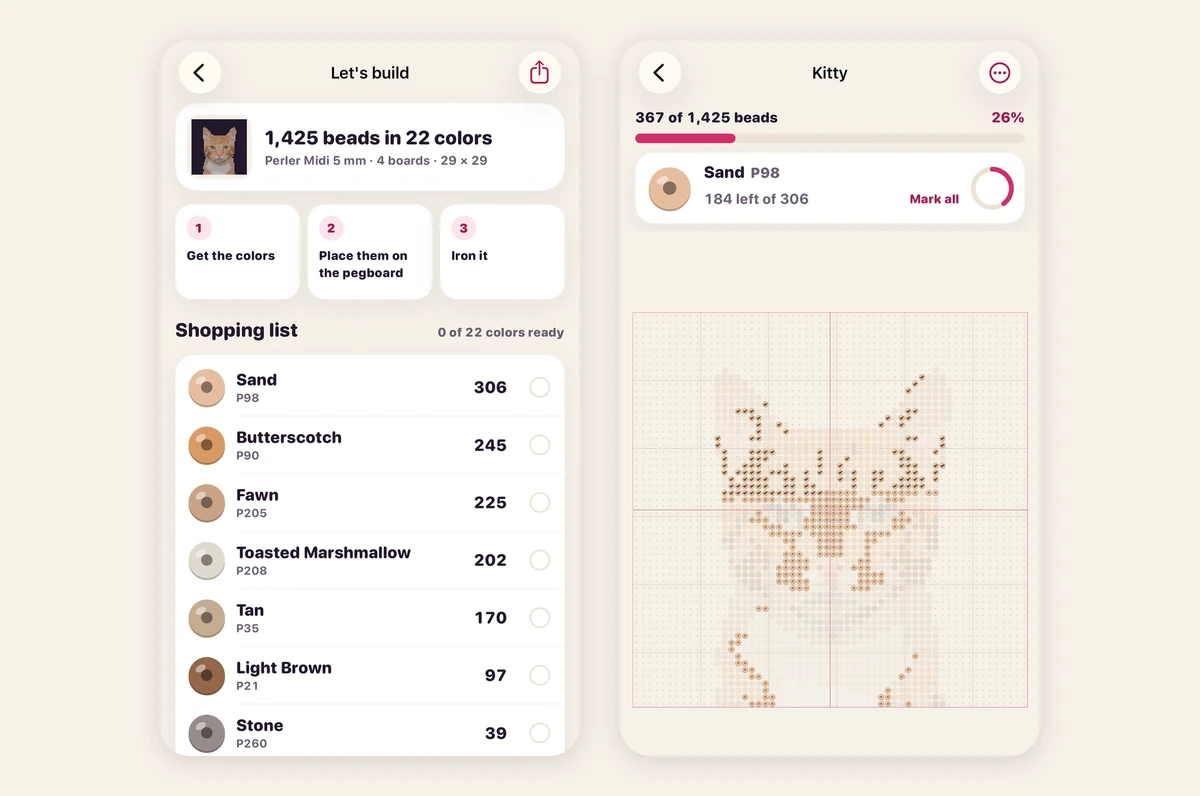
Here is a real pattern: an orange cat, made in BeadPop at the Detailed level (2 × 2 boards) with Perler colors. It needs 1,425 beads in 22 colors.
The biggest colors are Sand (306), Butterscotch (245), Fawn (225), Toasted Marshmallow (202), Tan (170), Light Brown (97), Stone (39) and White (37). Those eight add up to 1,321 beads. The other 14 colors share just 104 beads between them.
Now the bag math. Even with a 10% margin, the biggest color needs 337 beads, so every color fits in one bag of 1,000. Starting from nothing, that's 22 bags, or 22,000 beads, for a 1,425-bead piece. Multiply 22 by your local price per bag and you have the real cost.
The lesson: the number of colors drives the cost more than the number of beads. Three ways to spend less:
- Use what you have. Swap colors you don't own for close ones you do. Our Perler vs Hama vs Artkal vs MARD guide shows how close different brands' colors are.
- Go simpler. BeadPop's one-board Simple level uses 12 colors at most; the golden retriever above needed 12 instead of 22.
- Buy small colors in a mix. For colors you need fewer than 20 of, a mixed pack or a friend's stash beats a full bag.
Counting 1,425 beads by hand, color by color, is the most tedious step of any portrait. BeadPop does it for you: its shopping list gives the exact count of each color for 1 board, 2 × 2 or 3 × 3, and you tick off each color as you gather it. Build mode then shows one color at a time and how many beads of it are left.
Turn your own photo into a bead pattern
BeadPop turns any photo into a bead pattern with real bead colors and a shopping list.
When the beads are on the board, our guide to ironing Perler beads gets you through the last step without warping.
FAQ
How many beads fit on a 29x29 pegboard?
841 (29 × 29). That's the large square pegboard from Perler and the large square Midi pegboard from Hama.
How many pegs are on a Perler bead pegboard?
The large square board has 841 pegs. Mini, Biggie and shaped boards differ: count the pegs along one edge of a square board and multiply by itself.
How many Perler beads come in a bag?
Single-color bags hold 1,000 or 6,000 standard beads. Perler mini beads come in bags of 2,000.
How big is a finished 29x29 project?
About 14.5 cm (5.7 in) per side with 5 mm beads, a little less after ironing. With 2.6 mm minis, the same design is about 7.5 cm (3 in).
How many beads do I need for a 2x2 project?
A 2 × 2 layout holds 3,364 beads if every peg is filled. A portrait with an empty background usually needs far fewer: our examples covered about 40% of the pegs.
How many beads should a beginner buy?
Buy for a specific pattern, not in general. Count the colors of your first design, add 10% and buy one bag per color. Black and white get used in almost every design, so they are the safest extra bags.
Turn your own photo into a bead pattern
BeadPop turns any photo into a bead pattern with real bead colors and a shopping list.