Perler Bead Earrings: How to Make Light, Cute Jewelry
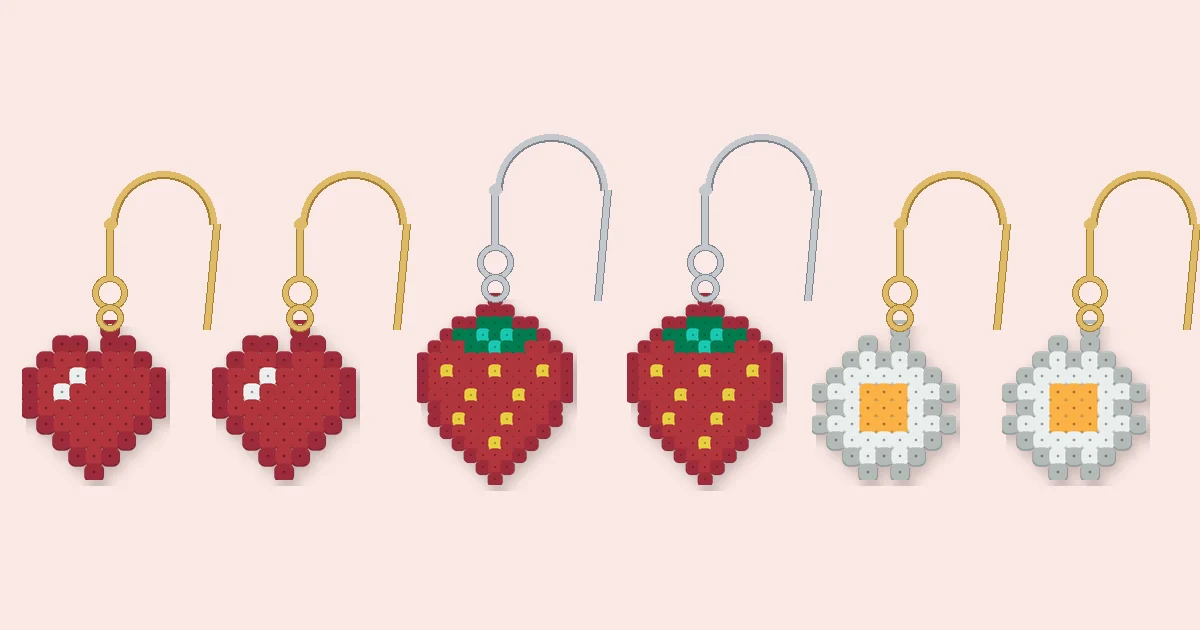
Perler bead earrings are small, bright and quick to make. One tiny design, one round at the iron, two jump rings and a pair of hooks, and you have a gift. The hard parts are the details: a hole that stays open, a piece that stays flat, and earrings light enough to wear all day. This guide covers bead size, findings, the steps, weight, other jewelry and a tiny portrait of your pet.
Everything here works the same with Hama beads, the brand most UK crafters use, and with Artkal or MARD.
Mini or regular beads for earrings?
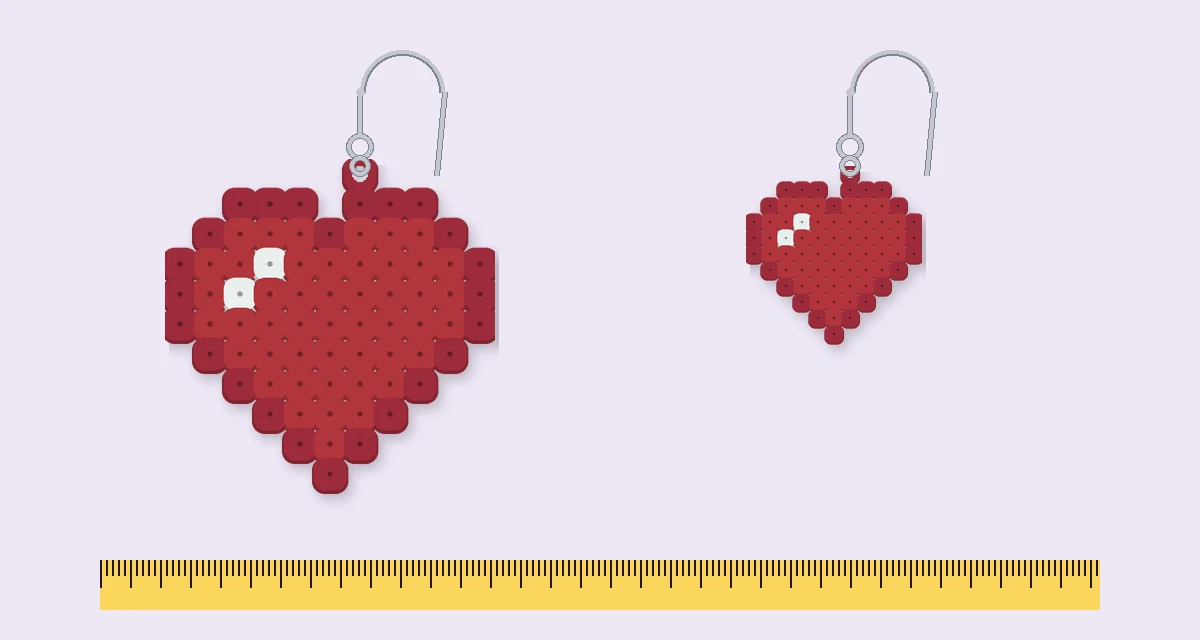
Regular Perler beads and Hama Midi beads sit on pegs about 5 mm apart. Perler lists its Mini beads at 2.61 mm wide, and Hama Mini beads are 2.5 mm. So a mini is about half the width of a regular bead and covers about a quarter of the area.
| Design width | Regular (5 mm) | Mini (about 2.6 mm) |
|---|---|---|
| 7 beads | 3.5 cm (1.4 in) | 1.8 cm (0.7 in) |
| 9 beads | 4.5 cm (1.8 in) | 2.3 cm (0.9 in) |
| 11 beads | 5.5 cm (2.2 in) | 2.9 cm (1.1 in) |
| 15 beads | 7.5 cm (3 in) | 3.9 cm (1.5 in) |
Minis are the classic choice. A 7-bead heart in minis is under 2 cm, a normal size for a dangle earring. Perler's own mini beads summer earrings use minis for exactly this reason.
Regular beads make statement earrings. A small regular-bead design, 5 to 7 beads across, works as a bold, playful earring. Anything wider starts to feel big and heavy.
Minis need tweezers and patience. Perler lists them for ages 12 and up, and Hama recommends its Minis from age 10. Our mini Perler beads guide covers boards, tweezers and brand sizes.
Findings you need (hooks, studs, jump rings, glue)
For dangle earrings you need these findings:
- Ear wires. Fish-hook wires are the easiest. Lever-backs close shut and are harder to lose.
- Jump rings. Small split metal rings that join the bead piece to the ear wire. Perler's summer earrings use 1/4 in rings, and its bracelet and earring sets use 6 mm rings.
- Two pairs of small pliers, chain-nose or flat-nose, to twist jump rings open and shut.
- Rubber earring backs to keep fish hooks from slipping out.
For stud earrings, swap the wires for flat-pad stud posts and backs, and add glue. Fused beads are polyethylene, a plastic many glues barely grip. Regular super glue doesn't bond it reliably. A plastics super glue with an activator, sold for polyethylene, works best for small pads. Hot glue holds but leaves a thick lump behind the ear. Test any glue on an ironed scrap before you glue a gift.
Pick metals for sensitive ears. Earrings are one of the most common causes of nickel allergy. The American Academy of Dermatology suggests jewelry labeled nickel-free or hypoallergenic, or made of surgical-grade stainless steel, sterling silver, platinum or high-karat yellow gold. Buy ear wires and studs that say so on the pack. The jump ring doesn't touch skin, so it matters less.
How to make Perler bead earrings, step by step
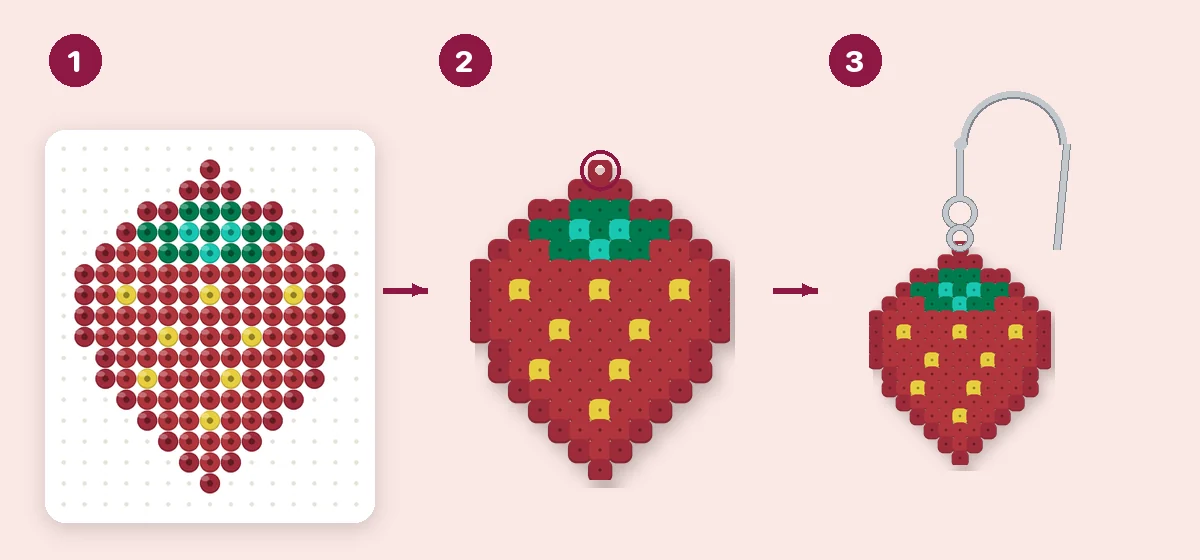
- Build two copies of the design, mirror images if the shape isn't symmetrical. Start with the outline, then fill.
- Add one tab bead centered above the top row. This bead becomes the hanging loop.
- Iron the front. An adult's job. Use ironing paper and keep the tab bead's hole open (see below).
- Cool, flip and iron the back the same way, then cool the piece flat under a book.
- Open a jump ring by twisting the ends sideways with two pliers. Never pull the ends apart into an oval: it weakens the ring and leaves a gap.
- Thread the ring through the tab hole, slide on the ear wire's loop and twist the ring shut so the ends meet flush.
- Check the hang. Hold the earring up. If it tilts, the tab is off center; move it on the next pair.
Leaving a hole for the jump ring
The jump ring needs a bead with an open center. Perler's projects all attach the ring through an open hole in the fused piece. Two ways to get one:
- A tab bead on top. One bead above the center of the top row, as in the strawberry above. It keeps the ring outside the design, so the earring hangs straight and the picture stays whole.
- A bead in the top row. Fine for shapes with a flat top, like a square or a letter. Pick the center bead.
Either way, that bead must stay open. Iron in light circles and stop when the beads have joined but their centers still show. Perler's rule for all its projects is the same: properly ironed beads still have open centers. If the hole does close, open it again with a fine pin vise or hand drill, not a hot needle.
Ironing tiny pieces flat
Small pieces warp fast because there is so little to hold them flat.
- Medium heat, no steam. Perler's mini earrings use the medium setting for about 10 seconds per side. Hama recommends the wool setting for Mini beads, one step cooler than for its regular beads. Regular beads take a little longer, about 10 to 20 seconds.
- Small circles, no pressing. Let the iron's weight do the work.
- Iron both sides, so the piece is strong enough to swing on a ring without snapping.
- Cool it under a book right after each side.
- Iron both earrings together on one board, so they come out the same.
Our guide to ironing Perler beads covers paper, heat and fixing a warped piece.
Are Perler bead earrings heavy?
They can be. Weight is what decides whether people wear your earrings or leave them in a drawer. Four things keep them light:
- Use minis. The same design in minis covers about a quarter of the area of regular beads, so it uses far less plastic.
- Keep it small. Each extra row adds a full line of beads. For dangles, 5 to 9 minis across is plenty.
- Cut out the shape. Leave the background empty, so the earring is only the heart, the fruit or the face.
- Choose light findings. Thin fish-hook wires and small jump rings add little.
The simplest test is your own ear. Wear the first pair for an hour before you make a batch to sell or give. A kitchen scale that reads to 0.1 g helps you compare designs.
Necklaces, bracelets, phone and bag charms
The same tab-and-jump-ring trick turns any small piece into other jewelry.
- Necklace pendant. Hang a slightly larger piece from a chain or cord with a jump ring. Perler's rainbow heart necklace skips the metal: it threads a ribbon through two beads near the top and ties a bow.
- Bracelet. Link several small minis with jump rings, or follow Perler's bracelet set, which weaves loose minis onto cord with a clasp.
- Phone charm. Hang a tiny piece on a phone strap loop.
- Bag charm. Bigger and sturdier, so regular beads work well. Add a lobster clasp or a split ring. Our Perler bead keychain guide covers rings and how to make them strong. Hama's jewelry and accessories page has free bag charm and brooch patterns, too.
Earring ideas: fruit, hearts, flowers, holiday sets
- Fruit. Strawberries, cherries, lemons and watermelon slices read well even at 7 beads wide.
- Hearts. The easiest first pair. Add one white bead in the upper lobe as a shine. Our Perler bead heart guide has hearts in every size.
- Flowers. Daisies, tulips and small rosettes. A white daisy with an orange center works on gold or silver.
- Holiday sets. Candy canes, small trees and stars in December, hearts for Valentine's Day, pumpkins in October.
Use a one-bead outline in a darker shade. At earring size, the outline is what makes the shape read from a distance.
A tiny portrait of your pet
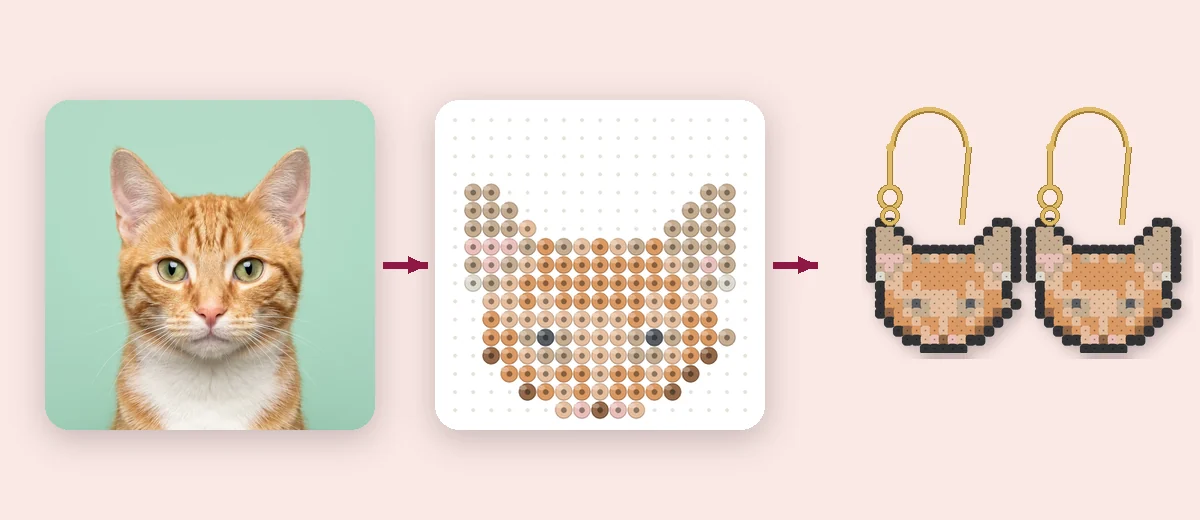
A pet face is the earring people ask about. It is also the hardest design to shrink. At earring size you only have about 15 to 17 beads across, so two things matter:
- Mini beads. In regular beads, a recognizable face gets too big for an ear.
- Few colors. Six to eight colors keep the eyes and markings clear. More colors at this size just look like noise.
By hand: print a close-up photo, draw a grid about 17 squares wide over the face, choose six to eight mini bead colors and fill each square with the closest one. Keep the eyes as single dark beads. Leave the background empty and add a black outline, so the earring follows the shape of the head.
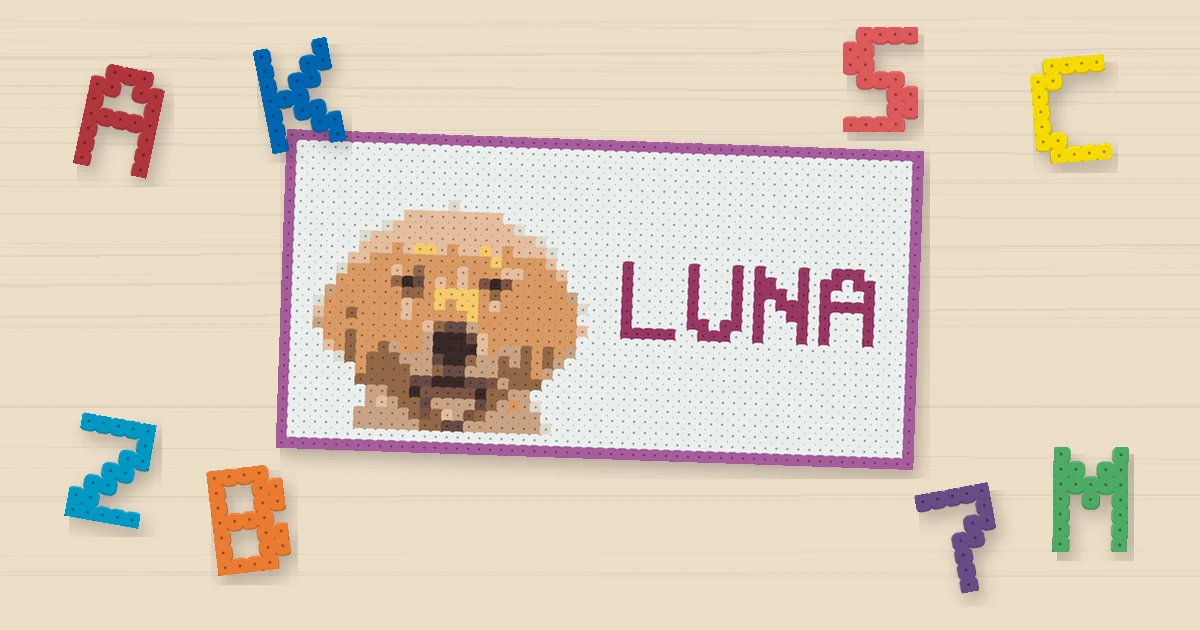
Matching and counting are the slow parts. BeadPop turns a pet photo into a mini-bead pattern on iPhone, in Perler Mini, Hama Mini, Artkal C or MARD colors, and gives you the exact count of each color. Our orange cat above came out 17 beads across: 133 beads in 7 colors, plus the outline. With the outline it is 19 beads, just under 5 cm (2 in) in Perler Minis. For a smaller pair, set the width lower.
Choose a photo where the face fills the frame, the eyes are sharp and the light is even.
Turn your own photo into a bead pattern
BeadPop turns any photo into a bead pattern with real bead colors and a shopping list.
Are Perler bead earrings safe for kids?
Making them is a good craft for older kids, with a few rules:
- Loose beads are a choking hazard. Keep them away from children under 3.
- Findings are small parts, too. Jump rings, earring backs and stud posts go in a closed box.
- An adult irons. Kids place the beads; an adult handles the iron and any glue.
- Ears. Choose nickel-free or hypoallergenic ear wires, and stop wearing a pair that makes the skin red or itchy.
FAQ
What size beads are best for Perler bead earrings?
Mini beads, about 2.6 mm (Perler) or 2.5 mm (Hama). A 7-bead design is under 2 cm. Regular 5 mm beads make bigger statement earrings.
How do you attach earring hooks to Perler beads?
Leave one bead with an open hole, usually a tab bead on top. Twist a jump ring open, pass it through the hole, add the ear wire and twist it shut.
What glue holds stud posts on fused beads?
A plastics super glue with an activator, sold for polyethylene. Regular super glue doesn't bond fused beads reliably.
Can you make earrings with Hama beads?
Yes. Hama Mini beads are 2.5 mm and work just like Perler Minis. Hama recommends the wool setting on the iron for them.
Turn your own photo into a bead pattern
BeadPop turns any photo into a bead pattern with real bead colors and a shopping list.