Melty Beads for Kids: Ages, Safety and First Projects
Melty beads can keep a child busy for a whole afternoon, and at the end there's something real to hang on the fridge. The questions parents ask are always the same: what age, how safe, and who holds the iron. Here are the answers from the bead brands and child-safety experts, plus eight easy first projects for a rainy day or the holiday break.
What are melty beads?
Melty beads are short plastic tubes. Kids place them on a pegboard, and an adult irons them. The heat softens each bead just enough to stick to its neighbors, and the design cools into one solid piece.
The name depends on where you live. Melty beads is the everyday name in Australia and common in the US. Many Americans say Perler beads, after the best-known US brand. In the UK most families know them as Hama beads, from the Danish brand. Fuse beads, iron beads and the kits in supermarkets and toy shops are the same idea.
What age are melty beads for?
Every brand prints an age on the pack, and it depends on the bead size. The smaller the bead, the older the child.
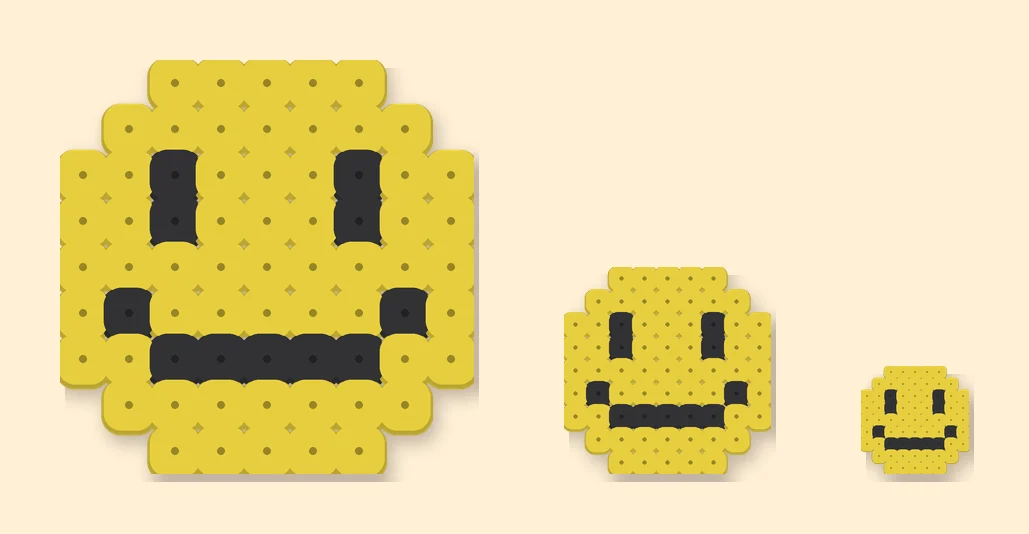
| Bead size | Brands | Width | Age on the pack |
|---|---|---|---|
| Big | Perler Biggie, Hama Maxi | about 10 mm | Biggie 4+, Maxi 3+ |
| Regular | Perler classic, Hama Midi | about 5 mm | Perler 6+, Midi 5+ |
| Mini | Perler Mini, Hama Mini | 2.6 mm, 2.5 mm | Perler 12+, Hama 10+ |
Hama explains its ages in a guide to its three bead sizes. Perler prints them on each product. Treat the numbers as a floor, not a target. A patient 5-year-old may love regular beads, while a restless 7-year-old may be happier with big ones.
Ages 3 to 5: Biggie or Maxi beads
Big beads are about 10 mm wide, twice the regular size, so small fingers can pinch them. Hama made its Maxi beads for the youngest children, whose fine motor skills are still developing, and suggests them from age 3. Perler labels its Biggie beads for ages 4 and up.
Big beads need their own boards, which our Perler bead pegboard guide compares. At this age, pick bold shapes in two or three colors.
Ages 5 to 9: regular 5 mm beads
This is the classic size. Hama recommends its Midi beads from age 5, and Perler labels its classic beads for 6 and up. A large square board holds 29 × 29 pegs, 841 in all, which is a lot for a first project. Start with small designs of 70 to 100 beads, like the eight further down, and fit several on one board.
Age 10 and up: mini beads and bigger pieces
Mini beads are about half as wide as regular ones: Perler lists 2.61 mm and Hama 2.5 mm. Hama suggests its Minis from age 10, and Perler labels its minis for 12 and up. They need their own pegboards, tweezers make placing easier, and they melt faster, so the adult at the iron uses less heat.
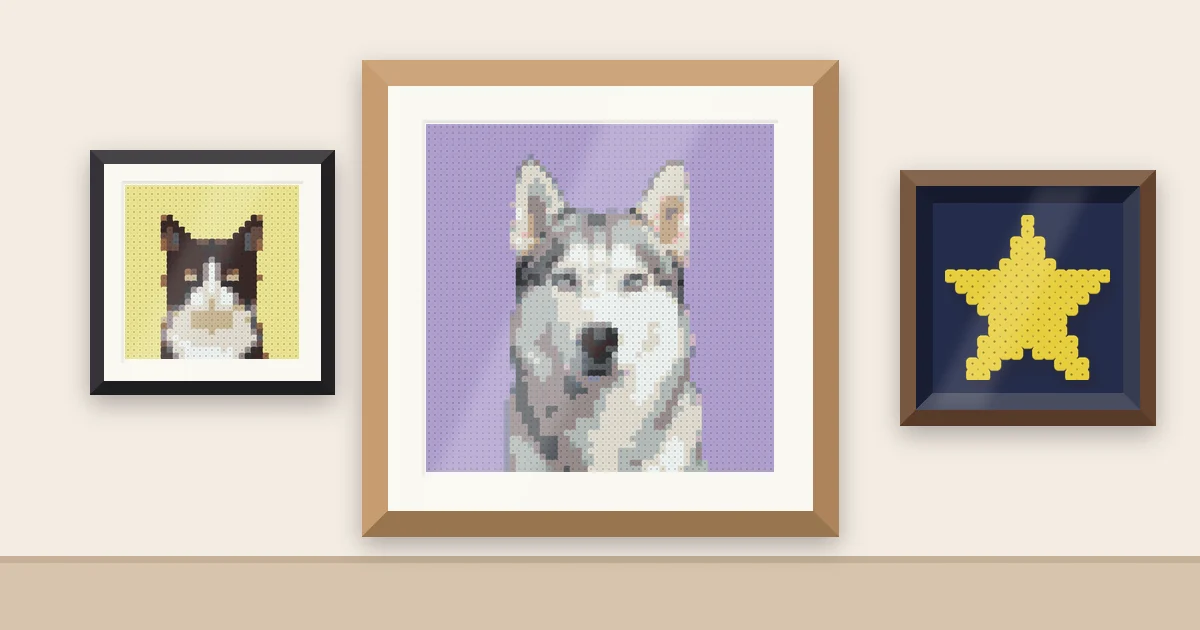
Older kids who find minis fiddly can go big instead: a name plate, a poster across several boards, or a portrait of the family pet in regular beads.
Are melty beads safe?
Yes, at the right age and with three rules. Loose beads stay away from children under 3. Beads never go in mouths. An adult handles the iron.
Small parts and choking
In the US, the Consumer Product Safety Commission bans small parts in toys for children under 3 because they can cause choking. Its test cylinder approximates the throat of a child under 3, and every fuse bead fits inside it, even a 10 mm Biggie. That's why even the big beads start at age 3 or 4.
Little brothers and sisters are often the real risk. The American Academy of Pediatrics notes on healthychildren.org that many choking incidents happen when older siblings give small objects to younger children. Bead at a table the baby can't reach, keep the lidded box up high and sweep the floor afterwards.
The same page lists the warning signs: a child who can't breathe, is gasping or wheezing, or turns bluish needs help right away. It also recommends a first aid and CPR course for parents.
What happens if a child swallows a bead?
Stay calm and watch the child's breathing. Call 911 (999 in the UK) at once if the child has trouble breathing, wheezes or makes a harsh sound when breathing in. Otherwise, call your child's doctor for advice. Seattle Children's Hospital says small blunt objects like toy parts are usually safe if not sharp, and that swallowed objects usually pass in a stool within 2 or 3 days. It also advises calling the doctor right away if the child is under 2.
Fumes
Hama had a lab measure what its beads release when ironed and says the air in the room is not harmful to breathe. The lab noted that high concentrations may irritate the mucous membranes, so keep the iron at the brand's setting and open a window during long sessions.
Who does the ironing? A simple rule by age
An adult, at every age. Perler's instructions say "Ask an adult to fuse your designs," and Hama says ironing must be done by an adult. Neither brand names an age when that changes. What changes is the child's job.
- Under 3: no beads at all.
- Ages 3 to 5: the child places the beads, then steps away. Iron on another counter, with the cord and the cooling iron out of reach.
- Ages 6 to 9: the child can watch from across the table. Once the first side has cooled, they can help flip the piece and slide it under a heavy book.
- 10 and up: older kids can learn the method by watching and calling it: holes still open means done. The brands still put the iron in adult hands, and so do we.
The method itself is short. Perler suggests a medium, dry iron with no steam, ironing paper on top and small circles for about 10 to 20 seconds per side, lifting the paper to check. Hama suggests the wool setting for Mini beads, cotton for Midi and linen for Maxi, and a test on a small piece first. Let the piece cool flat under a book. Our guide to ironing Perler beads covers warping, both sides and mini beads.
First projects for a rainy afternoon or the holiday break
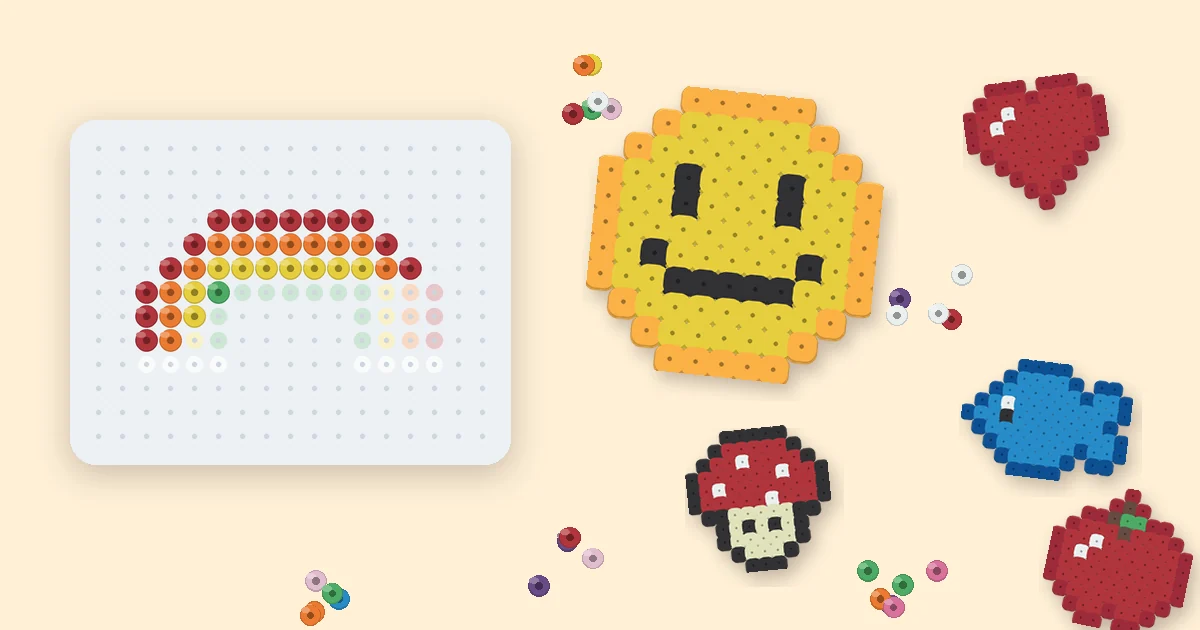
Small, bold designs work best for a first try. Each of these has a one-bead outline in a darker color, so a child can see the shape before filling it in.
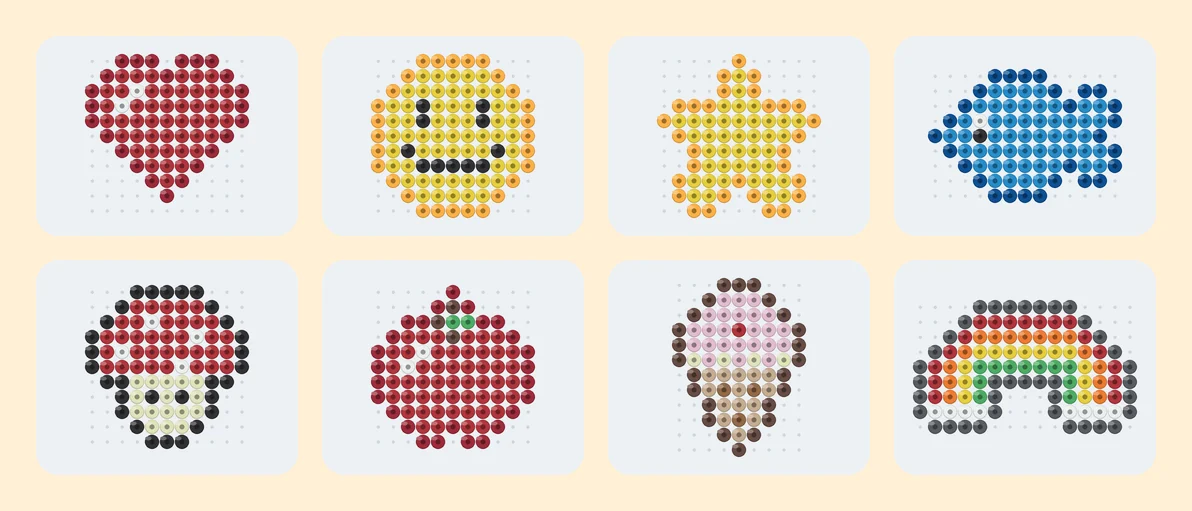
| Design | Size in beads | Beads |
|---|---|---|
| Heart | 11 × 11 | 73 |
| Smiley | 11 × 11 | 97 |
| Star | 11 × 11 | 71 |
| Fish | 13 × 9 | 82 |
| Mushroom | 11 × 11 | 85 |
| Apple | 11 × 11 | 84 |
| Ice cream cone | 9 × 12 | 70 |
| Rainbow | 15 × 9 | 102 |
With regular 5 mm beads, an 11-bead design is about 5.5 cm (2.2 in) wide. With big beads, double it.
Three tips help:
- Outline first, then fill. The outline shows the shape early, and kids stay motivated.
- Batch them. Fit three or four designs on one large board with an empty peg between them. The adult irons them all at once, and each comes off as a separate piece.
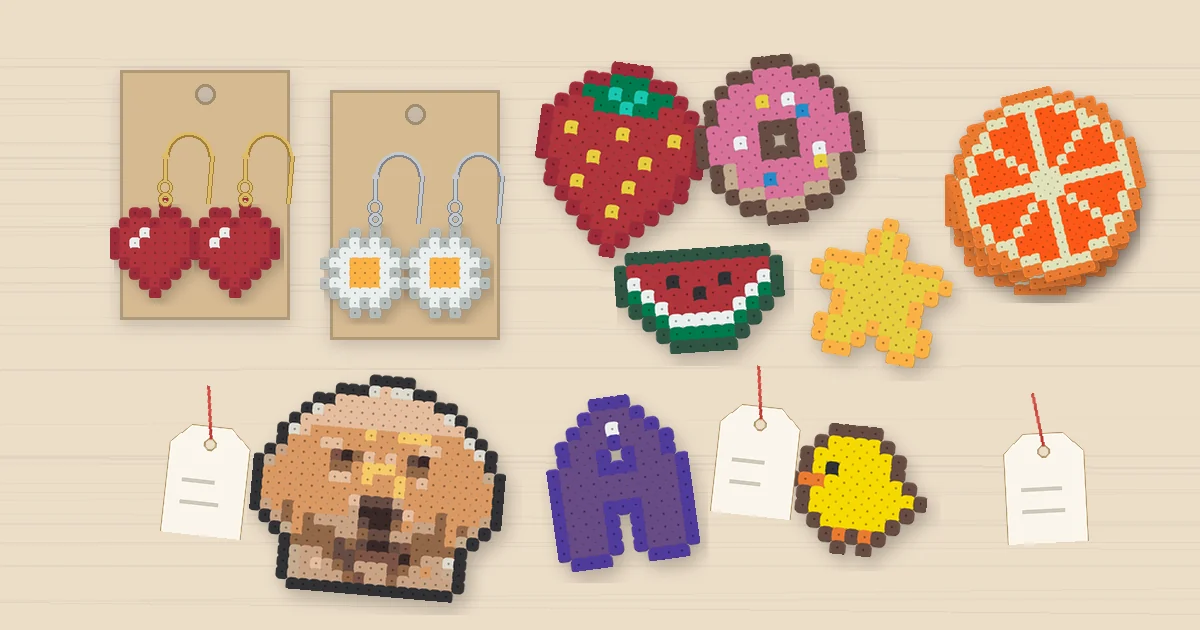
- Give them a job. A ribbon through a top bead makes a tree ornament; glued to a card, it's a gift.
When they want more, our list of 50 Perler bead ideas is sorted by skill level.
Turning your child's drawing into a bead pattern
A bead version of their own drawing beats any ready-made pattern, and grandparents love it.
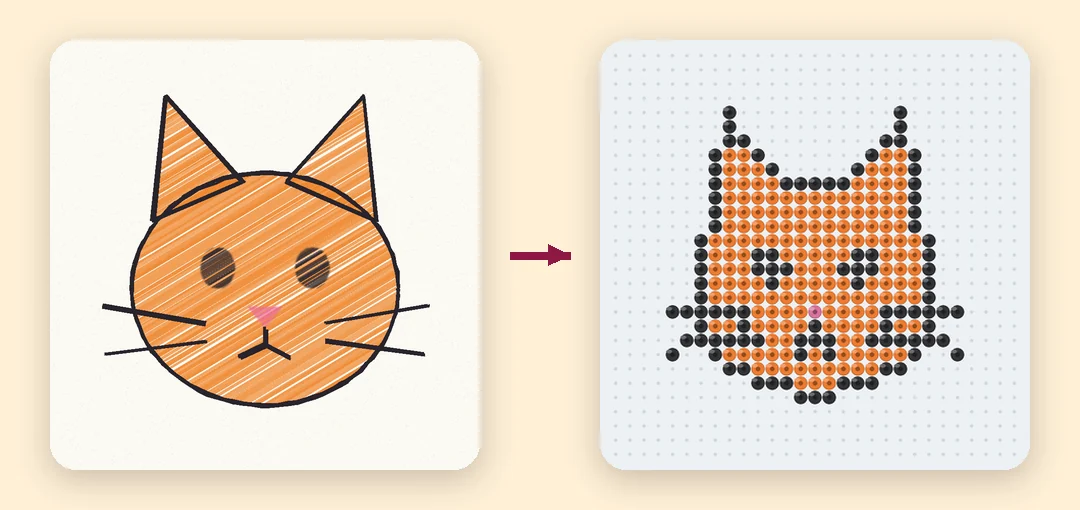
You can do it by hand:
- Pick a bold drawing. One subject, thick lines and a few colors convert best.
- Put it on a grid. Trace it onto graph paper, one square per bead. A 29 × 29 grid matches one large board, about 14.5 cm (5.7 in) across with 5 mm beads.
- Draw the outline one bead thick. If a line covers more than half a square, fill that square.
- Cut the colors. Three or four are plenty. Our cat uses orange, black and a single pink bead for the nose. Thin details like whiskers become one-bead lines.
- Count before you start. Tally each color so you don't run out of orange halfway.
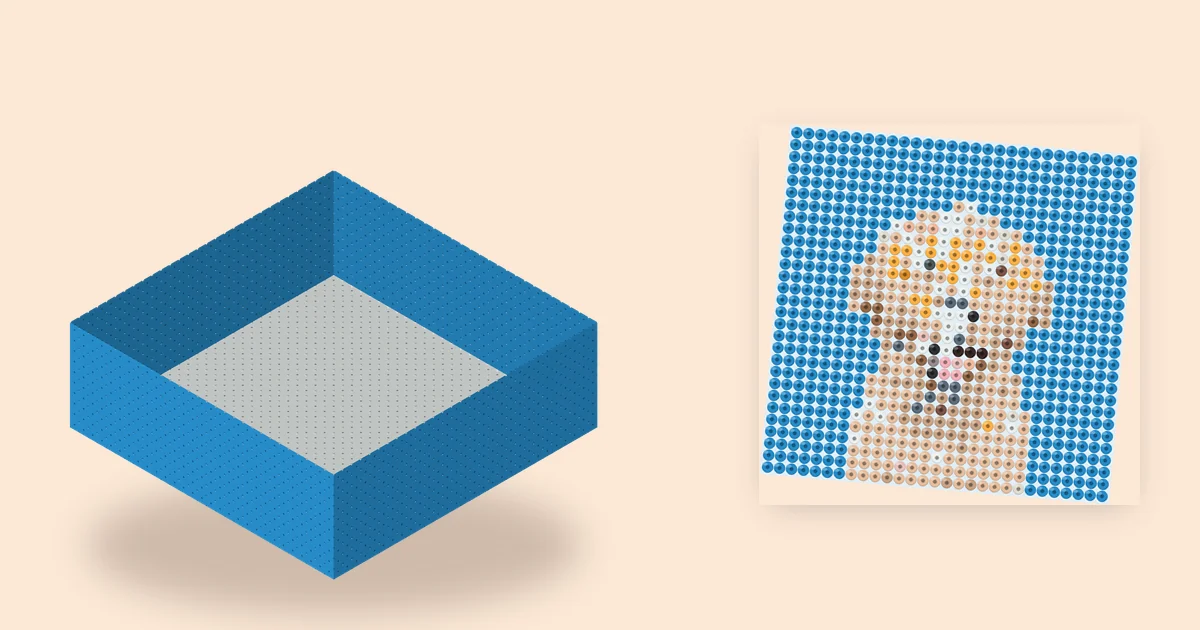
If tracing sounds like too much, BeadPop does it on iPhone. Take a photo of the drawing, or of the family pet, and it turns it into a pattern in the colors of the bead brand you have at home: Perler, Hama, Artkal, MARD or Nabbi. You get a count for each color. Its build mode highlights one color at a time, so a younger child can place all the orange beads, then all the black ones, without getting lost.
Turn your own photo into a bead pattern
BeadPop turns any photo into a bead pattern with real bead colors and a shopping list.
Keeping beads off the floor
Beads bounce, roll and hide. A little setup saves a lot of sweeping.
- Build on a tray with a lip. A baking tray catches strays and lets you move a half-built board out of the way.
- Put a towel underneath. Dropped beads land softly instead of bouncing across the room.
- Set out only a few colors. Pour four to six colors into small bowls or a muffin tin instead of opening the whole bucket.
- Store it high. Keep beads in a lidded box out of reach of little siblings. Our Perler bead storage guide has containers kids can manage.
FAQ
Are melty beads OK for toddlers?
Not for children under 3. Every fuse bead, even a 10 mm one, is a small part and a choking hazard at that age. Keep beads away from babies and toddlers, including while older kids are crafting.
Are Perler beads toxic?
Perler says its beads are made of low-density polyethylene, a food-grade plastic, and Hama's lab test found the air from ironing is not harmful. Beads still don't belong in mouths, and an adult should do the ironing.
Are Hama beads and Perler beads the same?
Same idea, slightly different sizes and colors. Hama Midi beads are 5 mm and Perler classic beads are 4.77 mm wide, so test-iron a mix before a big piece. Patterns work with either brand.
Turn your own photo into a bead pattern
BeadPop turns any photo into a bead pattern with real bead colors and a shopping list.