Perler Bead Pegboards: Types, Sizes and Which to Buy
A Perler bead pegboard is the plastic base that holds every bead upright while you build. The wrong one makes beads wobble, keeps your pattern from lining up, or runs out of room halfway through a portrait. Here are the main types, which boards fit which beads, how to join several and how to keep them flat. In the UK they're sold as Hama pegboards, and almost everything here applies to them too.
What types of pegboards are there?
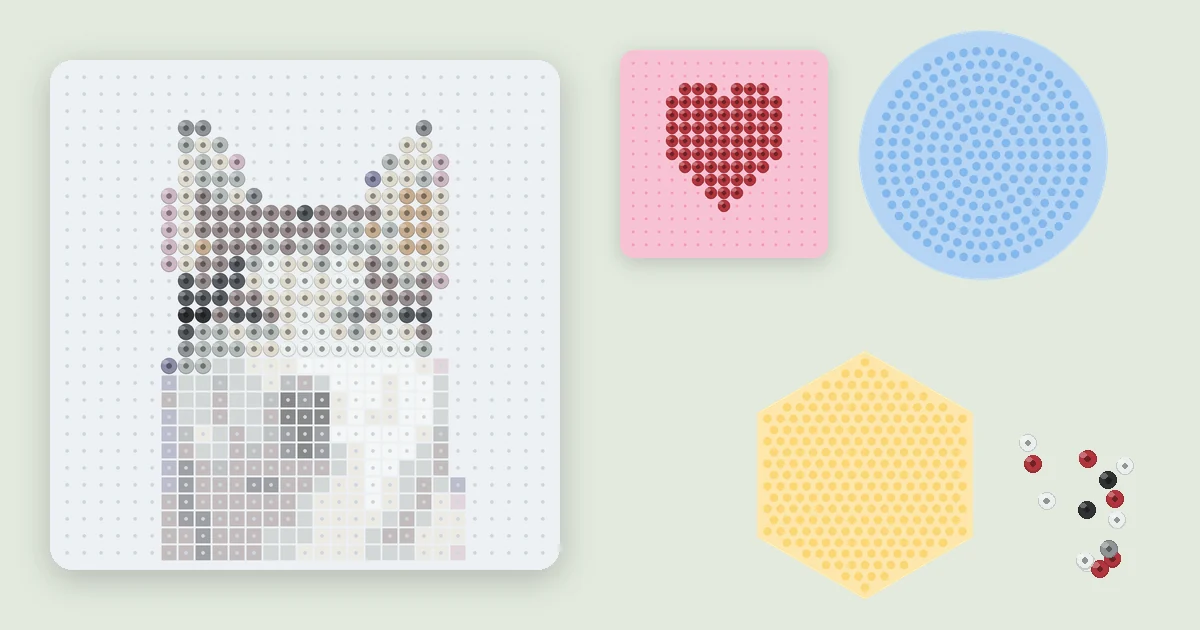
Every pegboard is a grid of pegs, one per bead. Boards differ in shape, size and the bead they're made for.
Large square pegboards
This is the board most patterns are drawn for. Perler's large square has 29 pegs per side, 841 in total, and measures 5.7 in (about 14.5 cm) across. Perler sells it clear and interlocking, so several boards join into a bigger surface. Hama's large square Midi pegboard has the same 841 pegs and connects with other boards of the same type.
If you buy only one kind of board, buy this one. A 29 × 29 grid fits keychains, coasters and simple portraits, and it grows in steps: 2 × 2 or 3 × 3 boards.
Small squares and shaped boards
Shaped boards come as circles, hexagons, stars and hearts, plus smaller squares. Perler's small basic shapes measure about 3 to 4 in across. They're quick wins for kids, because a small board fills up in one sitting. The shape also does half the design work: a hexagon becomes a flower or a coaster, a heart becomes a gift.
Two things to know before you buy:
- They hold fewer beads than a square of the same width.
- The pegs may not form a square grid. On many round and hexagon boards they follow the shape instead, so a pattern drawn on squares won't line up. Use patterns made for that board.
Clear or colored pegboards?
Clear boards let you build on top of a pattern. Print it at real size, slide the sheet under the board, and every empty peg shows the color it needs. Perler names this as the advantage of its clear boards. For portraits and anything with lots of colors, clear is the better buy. Our Perler bead grid guide shows how to print a pattern so it lines up with the pegs.
Colored boards are cheerful and give contrast, so a white or pale bead stands out while a child builds freehand. Perler sells its large interlocking squares in assorted colors, and Hama makes its large Midi square in a solid version and a transparent one.
A simple rule: clear for following patterns, colored for free play. If you only buy one set, make it clear.
Pegboards for mini and Biggie beads
Fuse beads come in three sizes, and each size needs its own board. The pegs are spaced to match the bead, so a bead on the wrong board won't line up with its neighbors.
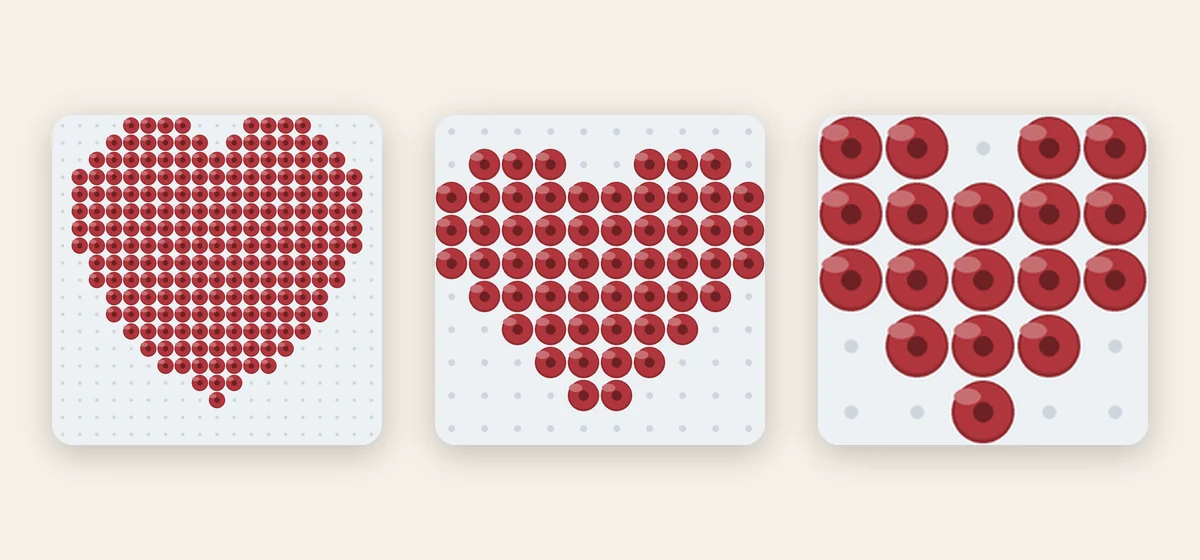
| Bead | Width | Large board | Ages (brand guidance) |
|---|---|---|---|
| Perler Mini | 2.61 mm | 5.875 in square | 12+ |
| Hama Mini | 2.5 mm | 57 × 57 pegs (3,249) | 10+ |
| Perler classic | about 5 mm | 29 × 29 pegs (841), 5.7 in | 6+ for the boards |
| Hama Midi | 5 mm | 29 × 29 pegs (841) | 5+ |
| Perler Biggie | about 3/8 in (roughly 10 mm) | 5.875 in square | 4+ |
| Hama Maxi | 10 mm | 16 × 16 pegs (256) | 3+ |
Mini boards. Perler's large mini pegboards measure 5.875 in square, interlock with Perler's other square mini boards and are labeled not for standard beads. Perler doesn't list their peg count, so count one edge of yours. Hama's large Mini square has 3,249 pegs and joins boards of the same type. Keep each brand's minis on that brand's board. Our guide to mini Perler beads covers tweezers, heat and the rest.
Biggie and Maxi boards. These are for small hands. Perler's clear Biggie boards are 5.875 in square and made for Biggie beads only. Hama's large Maxi square holds 256 beads, so designs stay simple and bold.
Do pegboards work across brands?
For standard 5 mm beads, generally yes. Perler's and Hama's large squares both hold 29 × 29 beads on a grid of about 5 mm, so Perler beads, Hama Midi beads and other 5 mm beads sit on either board.
Three limits:
- Connectors belong to each brand. Perler says its boards interlock with each other. Hama says its boards connect with boards of the same type. Neither promises that a Perler board will clip to a Hama board, so join boards from one line.
- Minis aren't one standard. A 2.5 mm Hama Mini and a 2.6 mm mini look the same, but the gap adds up over a long row. Match the board to the beads.
- Never mix bead sizes. Pegs are spaced for one size, so beads of another size won't line up or fuse evenly.
Colors and melting also differ between brands. Our Perler vs Hama vs Artkal comparison goes through both. BeadPop is not affiliated with Perler, Hama, Artkal or MARD.
How do you connect Perler bead pegboards?
A pattern wider than 29 beads needs more boards. Four boards make a 58 × 58 grid, and nine make 87 × 87.
- Join the boards first. Clip them together on a flat table before you place a single bead. Check that the seams sit flush and the rows run straight across.
- Stay in one line. Use boards of the same brand and type. Perler's mini boards are made to interlock with its other mini squares, and Hama's boards connect with boards of the same type.
- Put one page under each board. A good multi-board pattern prints one board per page, with a line every 29 squares. Tape each sheet under its own clear board.
- Build where you'll iron. Moving a loose design is how spills happen.
- Keep the boards joined until the piece is fused. If they drift apart, the seams open and beads drop between them.
For big designs, many crafters use the masking tape method: tape over the top, flip the design between two pieces of cardboard, lift off the boards and iron the back first.
Which Perler bead pegboard should you buy first?
For most people, the answer is large clear square boards for 5 mm beads. Get two if you're trying the hobby, or four if you want to try a 2 × 2 portrait.
Then adjust for who's building:
- Young children: Biggie or Maxi boards with matching beads. Hama recommends its Maxi beads from age 3, and Perler lists Biggie sets for ages 4 and up. Every fuse bead, even the big ones, is a small part and a choking hazard for children under 3, so supervise and sweep up strays.
- Kids from about 5 or 6: standard large squares. Perler lists its large boards for ages 6 and up, and Hama suggests Midi beads from age 5.
- Teens and adults who want detail: mini boards. Pick a clear one if you plan to build over a printed pattern.
- Quick crafts: add small shapes later. You'll still use the large square far more.
Whatever you buy, an adult does the ironing. Our guide to melty beads for kids covers ages, safety and easy first projects in more detail.
Matching project size to boards: 1 board, 2×2, 3×3
The number of boards decides how big the piece is and how much detail a picture gets. Here are the three common sizes with 5 mm beads. Widths are approximate, since the pegs sit about 5 mm apart.
| Boards | Grid | Max beads | Finished width | What a pet portrait gets |
|---|---|---|---|---|
| 1 | 29 × 29 | 841 | about 14.5 cm (5.7 in) | Head shape and main colors; each eye is a bead or two |
| 2 × 2 | 58 × 58 | 3,364 | about 29 cm (11.4 in) | Head and chest, clear markings, eye and nose shapes |
| 3 × 3 | 87 × 87 | 7,569 | about 43.5 cm (17.1 in) | Shading in the fur, expression, small highlights |
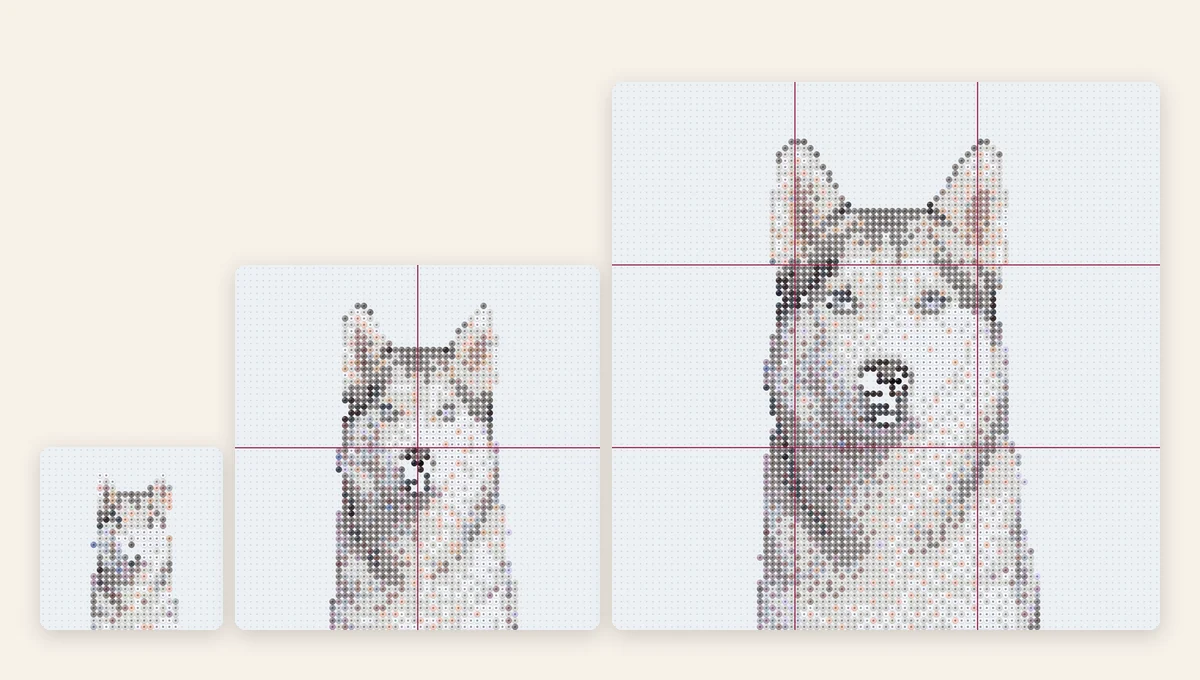
Most portraits don't fill every peg, because the background stays empty. To count the beads you'll really use, see how many Perler beads you need.
Pick 1 board for a first try, 2 × 2 when the pet's markings matter and 3 × 3 for a wall piece that shows the look in their eyes.
These are the same three sizes BeadPop offers. On your iPhone, you pick a photo, choose 1 board, 2 × 2 or 3 × 3, and choose your beads: Perler, Hama, Artkal, Nabbi or a mini line. The app builds the pattern and a shopping list with the number of beads per color and each brand's code. Missing a color? Swap it for one you own. Then print the PDF at real size. It splits a big pattern per board, so each sheet goes under its own clear pegboard and the seams on paper match the seams between your boards.
Turn your own photo into a bead pattern
BeadPop turns any photo into a bead pattern with real bead colors and a shopping list.
Caring for pegboards (heat, warping, cleaning)
A pegboard is thin plastic, and heat is its enemy. Treat it well and a set lasts for years.
- Always use ironing paper. Perler's FAQ is firm about it: always use paper, and never put the iron directly against the beads or the pegboard.
- Keep the iron off bare pegs. Hama warns that touching the pegboard with the iron damages the pegs. Cover the whole design with paper, leave a margin, and keep the iron inside it.
- Go easy on heat. Perler notes that too high a temperature can warp the board. Start at medium with no steam, and turn it up only if the beads aren't joining.
- Let it cool before you lift. Hama suggests a few minutes of cooling before you take the design off the board. Warm plastic bends easily.
- Store boards flat, away from heat. The plastic that warps under an iron won't like radiators, sunny windowsills or hot cars either. Stack boards flat in a box instead of standing them on edge.
- Clean by hand. Shake out stray beads. If a board gets sticky, wash it in lukewarm soapy water, rinse it and let it dry flat. Skip the dishwasher, since a hot cycle can bend thin plastic.
A warped board won't hold beads level. If yours rocks on a flat table, keep it for free play.
FAQ
How many pegs are on a Perler bead pegboard?
The large square has 29 pegs per side, 841 in total. Small squares and shaped boards hold fewer. Perler doesn't list peg counts for its mini boards, so count one edge of yours.
What size is a large Perler pegboard?
It's 5.7 in square, about 14.5 cm. A 2 × 2 block is about 29 cm (11.4 in) wide.
Can you use Hama beads on a Perler pegboard?
Hama Midi beads, yes. Both are about 5 mm and fit 29 × 29 boards. Hama Mini and Maxi beads need their own boards.
Do you iron Perler beads on the pegboard?
Yes, for the first side. Cover the beads with ironing paper and iron through it, never on the bare board. Once it cools a little, lift the design off and iron the back without the board.
Are clear pegboards worth it?
Yes, if you follow patterns. You slide a real-size printout under the board and cover each colored square, so you never count rows.
Turn your own photo into a bead pattern
BeadPop turns any photo into a bead pattern with real bead colors and a shopping list.