Perler Bead Flowers: Easy, 3D and Bouquet Patterns
A Perler bead flower is about the friendliest project there is. It's small, it needs three or four colors, and a slightly wonky petal still looks like a petal. The same skills then take you from a one-color daisy to a shaded rose, a 3D bouquet, or a keepsake of a real bouquet made from a photo.
In the UK most people call them Hama beads. The patterns and tips below work the same with Hama, Artkal and other 5 mm fuse beads.
Easy Perler bead flowers for beginners
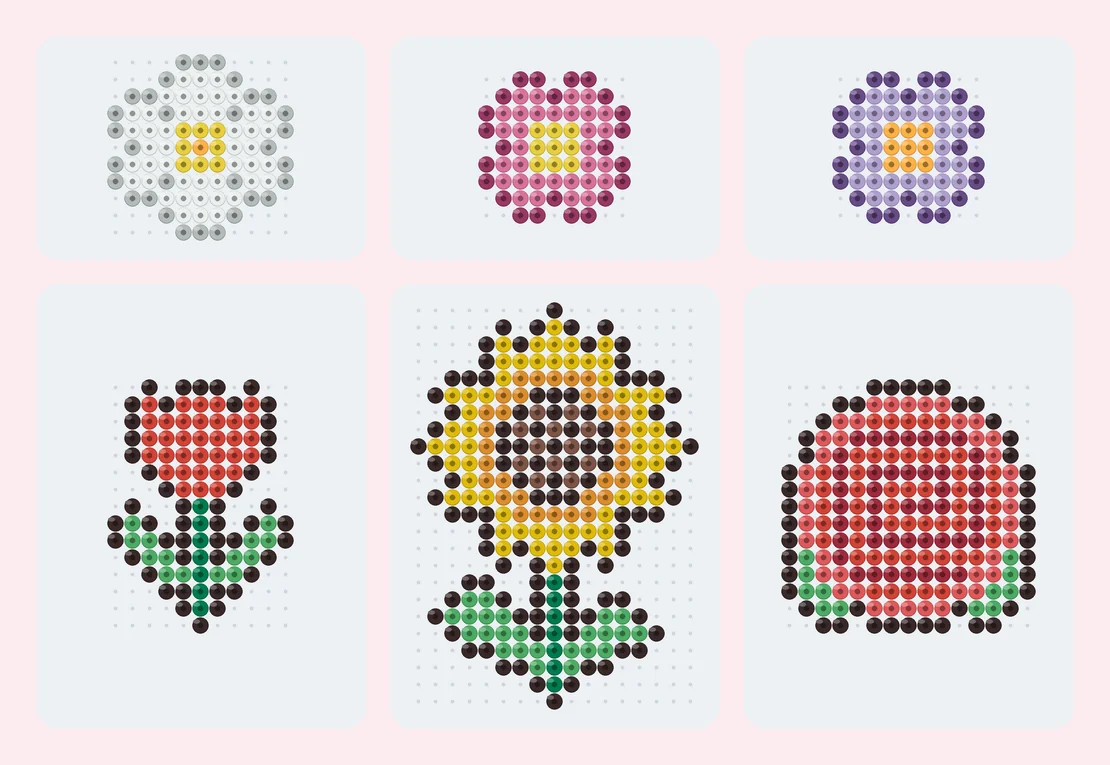
Each fits on a large 29 × 29 pegboard. Sizes include the outline; each bead takes about 5 mm.
| Flower | Size in beads | Beads | Finished size | Main colors |
|---|---|---|---|---|
| Small four-petal flower | 9 × 9 | 65 | about 4.5 cm (1.8 in) | Bubblegum (P06) with a Yellow (P03) center, or Lavender (P182) with Cheddar (P57) |
| Daisy | 11 × 11 | 87 | about 5.5 cm (2.2 in) | White (P01), Yellow (P03) center |
| Tulip with stem | 11 × 15 | 103 | about 5.5 × 7.5 cm (2.2 × 3 in) | Tomato (P211) and two greens |
| Rose seen from above | 15 × 15 | 193 | about 7.5 cm (3 in) | Tomato (P211), Cherry (P961), Hot Coral (P59) |
| Sunflower with stem | 17 × 24 | 238 | about 8.5 × 12 cm (3.3 × 4.7 in) | Sunflower (P268), Honey (P249), Cocoa (P262), Gingerbread (P250) |
Small four-petal flower (65 beads)
The fastest flower in the set: four rounded petals around a square center. The pink and lavender versions share one layout, so make a batch in every color you own.
Look at the outlines. The pink flower has a darker pink edge and the lavender one a dark purple edge, not black. On small, soft flowers, a darker shade of the petal color keeps the shape clear without looking heavy.
Daisy (87 beads)
White petals, a yellow center and a grey outline. White beads vanish on a white table, so set your clear pegboard on a dark surface. Place the center first, then the outline, then fill the petals.
Tulip (103 beads)
The first flower with a stem and leaves. The cup has three points, the stem is dark green and the leaves a lighter green. With outline beads on both sides, the stem is really three beads wide and won't snap. Remember that when you draw your own: a stem of single beads is the first thing to break.
Sunflowers, roses and other favorites
Sunflower (238 beads)
The biggest pattern here. The petals use Sunflower (P268) on the tips and Honey (P249) near the center. The center mixes two browns, Cocoa (P262) and Gingerbread (P250), in a checkerboard that reads as seeds. If you can't find Sunflower, Yellow (P03) is a slightly lighter stand-in.
Perler's own sunflower bouquet turns bead sunflowers into a fall arrangement in a basket.
Rose seen from above (193 beads)
A rose from the side is hard at small sizes. From above, it's just a spiral. This one uses Tomato (P211) as the base, a Cherry (P961) line winding out from the middle and Hot Coral (P59) on the outer petals, which catch more light.
For a pink or yellow rose, keep the layout and pick three shades of one color: light outside, dark in the spiral.
Flower-shaped pegboards
You don't always need a pattern. Perler's Small Garden & Novelty set includes a flower board (3.12 × 5.37 in) and a tulip board. Hama's flower Midi pegboard has 291 pegs, and its small flower board has 120. Fill them in rings of color, center first.
How do you shade petals with only a few colors?
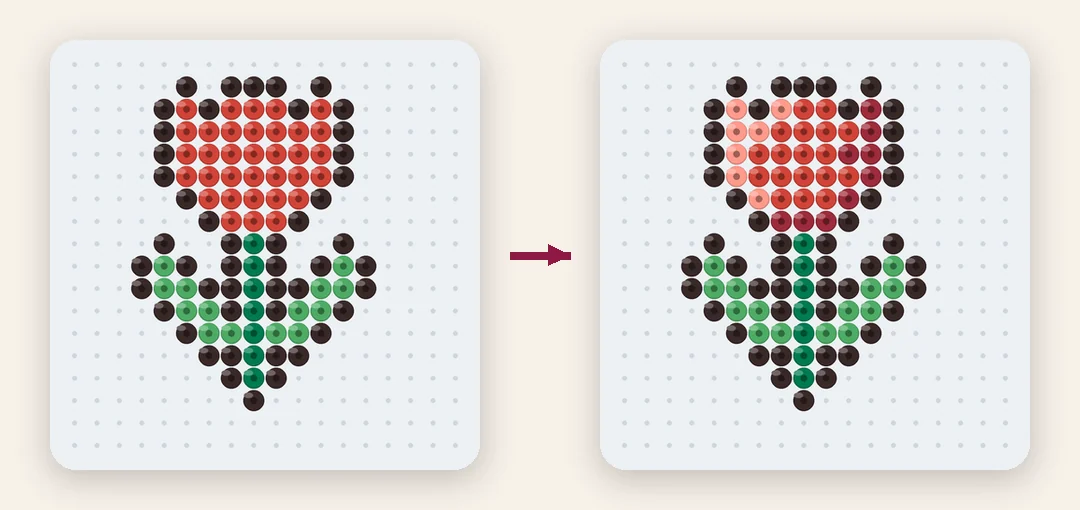
A flower in one flat color looks like a sticker. Add two shades and it looks round. The tulip above goes from all Tomato (P211) to Tomato with a Coral (P272) highlight and a Cherry (P961) shadow.
- Pick where the light comes from. Here, the left.
- Choose three steps of one color: light, base and dark. They should look like neighbors; a jump from red to pink reads as a pattern, not as shade.
- Put the highlight on the edges facing the light. A column or two is enough.
- Put the shadow on the far side and where the petals meet the stem.
- Keep most beads in the base color. Shading is a handful of beads, not half the flower.
For a yellow flower, try Rich Butter (P274), Yellow (P03) and Honey (P249). For leaves, Kiwi Lime (P61) on the sunny side and Dark Green (P10) underneath.
How do you make 3D flowers and a bouquet?
Flat flowers become a bouquet in three ways.
- Curved petals on a stem. Perler's floral bouquet fuses each petal and leaf separately, bends them up a little while warm, then slides them onto a stem. It's wrapped in a 10-inch square of kraft paper and tied with ribbon, a Mother's Day idea. The stem passes through the bead holes, so fuse lightly. If a hole closes, Perler suggests twisting closed tweezer tips in it to reopen it.
- Layers shaped over a ball. The sunflower bouquet stacks front, middle and bottom layers, curving the lower two over a ball about the size of a tennis ball while warm. Each flower gets a bamboo skewer hot-glued to the back, and floral foam holds the skewers in the basket.
- Slot-together flowers. Two identical flat flowers with matching slots cross into one that stands on its own. Our 3D Perler beads guide shows how to build the slots.
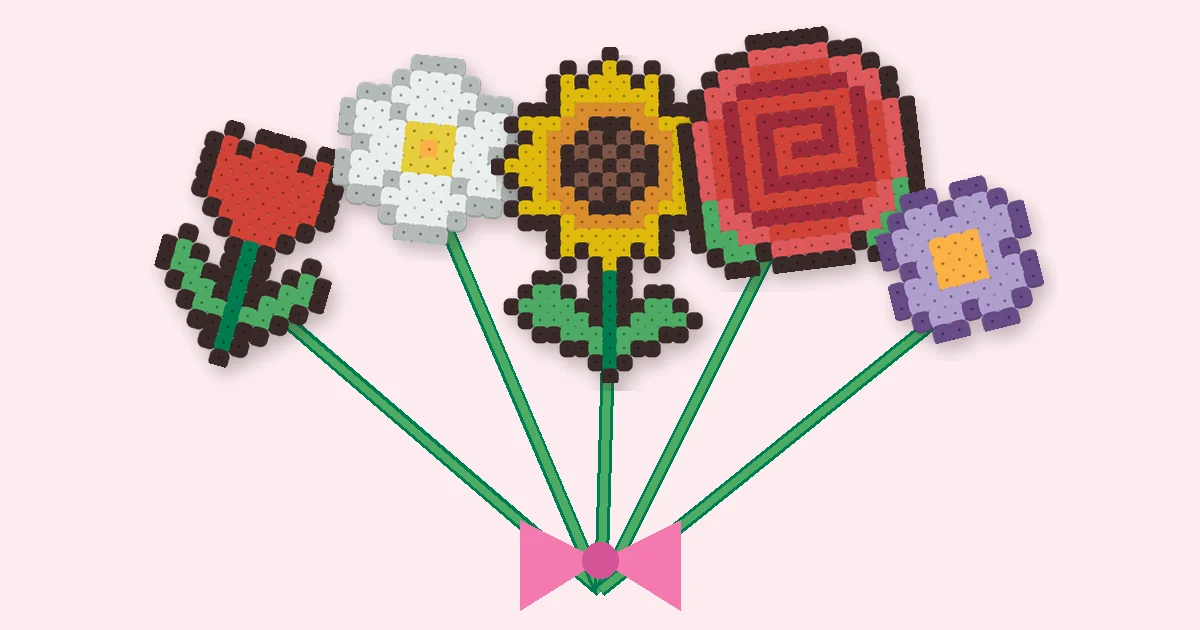
The easiest bouquet is the one on our cover: flat flowers on skewers, tied with a bow.
Ironing rules for flowers: an adult does the ironing and the hot glue. Perler's projects use medium heat with no steam, ironing paper on top and about 10 to 20 seconds per side. Fuse both sides, since petals get handled a lot, and cool flat pieces under a heavy book. Shape curved pieces while warm instead; Perler notes fused beads stay flexible until they cool.
Useful flower projects: coasters, magnets, keychains, frames
- Keychains and bag charms. The small four-petal flower is the right size. Keep one bead hole near the top open for a jump ring.
- Magnets. Glue a small magnet to the back of a daisy or tulip.
- Coasters. Put one flower in the middle of a full 29 × 29 board, about 14.5 cm (5.7 in) square, with a plain background.
- Frames. Run a chain of daisies around a photo frame, or frame a flat bouquet.
- Bugs to go with them. A bee or a ladybug on a leaf finishes a garden scene. Our Perler bead animals guide has small critters that sit well next to these flowers.
Turning a real bouquet into a bead keepsake
A wedding bouquet wilts in days, and so does the first rose from the garden. A bead version stays bright for years. It starts with a photo.
Taking the photo
- Shoot it fresh, before the petal edges brown.
- Use daylight near a window, with no flash.
- Shoot from above or straight on against a plain background, like a white sheet.
- Fill the frame with the flowers.
The manual route
- Crop to what matters: the top of the bouquet or one standout bloom. Ribbons and long stems can go.
- Pick a size. One 29 × 29 board holds a single flower with shading. Several recognizable flowers need about 2 × 2 boards (58 × 58 beads) or more.
- Simplify. Three tones per flower, two for the greenery, one dark outline. Ten to twelve colors is plenty.
- Draw it on grid paper, one square per bead.
- Match each color to your brand's chart and count the beads per color before you buy.
Or let your phone make the pattern
Steps 3 to 5 are the slow part: a photo has thousands of shades, and a pegboard needs a few dozen colors you can buy. BeadPop does that part on iPhone. It removes the background and matches every bead to real colors from the brand you own: Perler, Hama, Artkal, MARD or Nabbi. Pick one board for a single bloom or a multi-board size for the whole bouquet. If a petal comes out the wrong shade, say a blush rose that turned salmon, color adjust swaps that shade, and touch-up fixes single beads. You get a shopping list with the count and brand code of each color, a PDF that prints at real size to slide under a clear pegboard, and a build mode that highlights one color at a time and saves where you stopped. The photo stays on your phone.
Turn your own photo into a bead pattern
BeadPop turns any photo into a bead pattern with real bead colors and a shopping list.
A bead bouquet makes a lovely anniversary or Mother's Day present. Our DIY photo gifts guide has more ideas that start with a photo.
Which bead colors work best for flowers?
These Perler colors cover most flowers, including the in-between shades that do the shading:
| Use | Perler colors (code) |
|---|---|
| White petals | White (P01), with Toasted Marshmallow (P208) or Light Grey (P181) for shade |
| Yellows | Rich Butter (P274), Yellow (P03), Sunflower (P268), Honey (P249), Cheddar (P57) |
| Reds | Coral (P272), Hot Coral (P59), Tomato (P211), Red (P05), Cherry (P961) |
| Pinks | Light Pink (P79), Blush (P63), Bubblegum (P06), Pink (P83) |
| Purples | Lavender (P182), Pastel Lavender (P54), Plum (P60), Purple (P07) |
| Greens | Kiwi Lime (P61), Bright Green (P80), Shamrock (P199), Dark Green (P10), Evergreen (P179) |
| Centers and outlines | Gingerbread (P250), Brown (P12), Cocoa (P262), Black (P18) |
- Buy two greens, one light and one dark. Every stem looks better with both.
- Pick one outline color and buy plenty. Outlines use more beads than you'd think.
- Check names by brand. Hama uses its own numbers and names, so use Hama's colour chart for UK projects. Our Perler bead color chart lists every Perler code and the closest Hama match for common shades.
FAQ
How many beads does a Perler bead flower take?
Our six patterns take between 65 beads (the small four-petal flower) and 238 (the sunflower). Perler sells single colors in bags of 1,000, so one bag of each main color covers several flowers.
Can kids make Perler bead flowers?
Yes. Kids place the beads; an adult does the ironing and any hot glue. Perler's garden pegboard set is for ages 6 and up, and Hama lists its flower boards from age 5. Loose beads are a choking hazard, so keep them away from children under 3.
How do you make Perler bead flowers stand up?
Slot two identical flowers together, or glue each flower to a skewer and push the skewers into floral foam in a pot or basket.
Do these patterns work with Hama beads?
Yes. Hama Midi beads are the same 5 mm size and fit the same 29 × 29 grid. Only the color names and numbers change.
Turn your own photo into a bead pattern
BeadPop turns any photo into a bead pattern with real bead colors and a shopping list.