Perler Bead Heart Patterns: Small, 3D and Photo Hearts
A Perler bead heart is the first thing most people make, and the gift they keep making. The smallest takes 18 beads. A big one can frame a portrait of your pet or your partner. Here are heart patterns at every size, tricks for a smooth curve, 3D and jointed hearts, quick gifts, and a plan for a heart border around a photo portrait.
Everything here works the same with Hama Midi beads, the name most UK crafters know, and with Artkal or any other 5 mm fuse beads.
Small Perler bead heart patterns
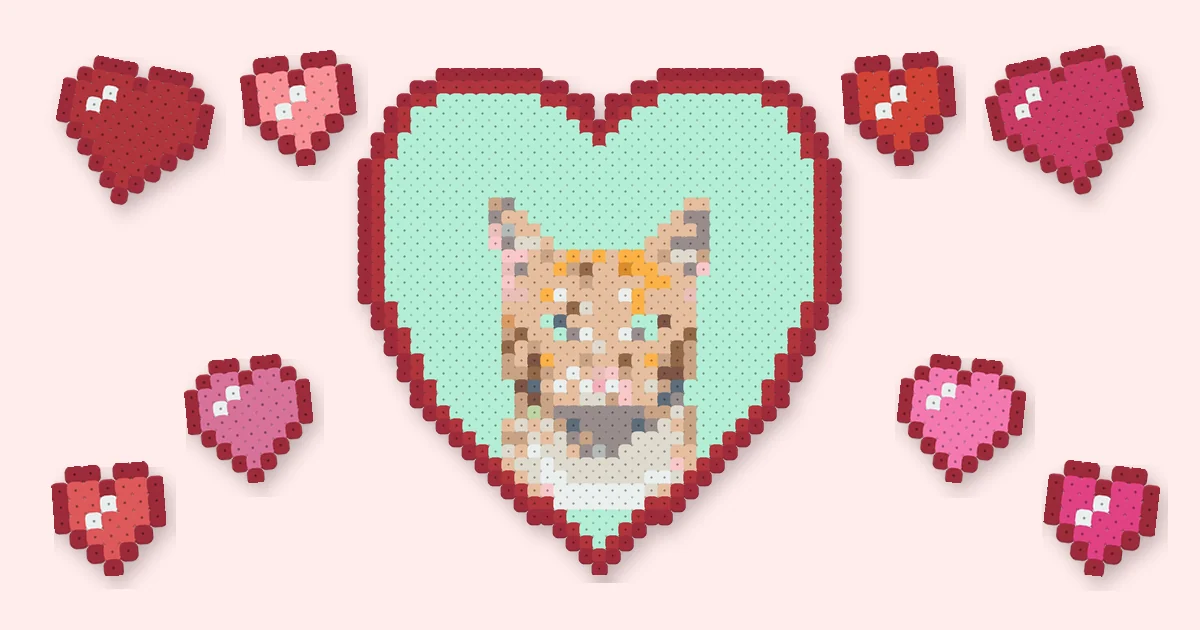
Small hearts are the best way to fill one large square pegboard (29 × 29 pegs): build a batch and iron them all at once.
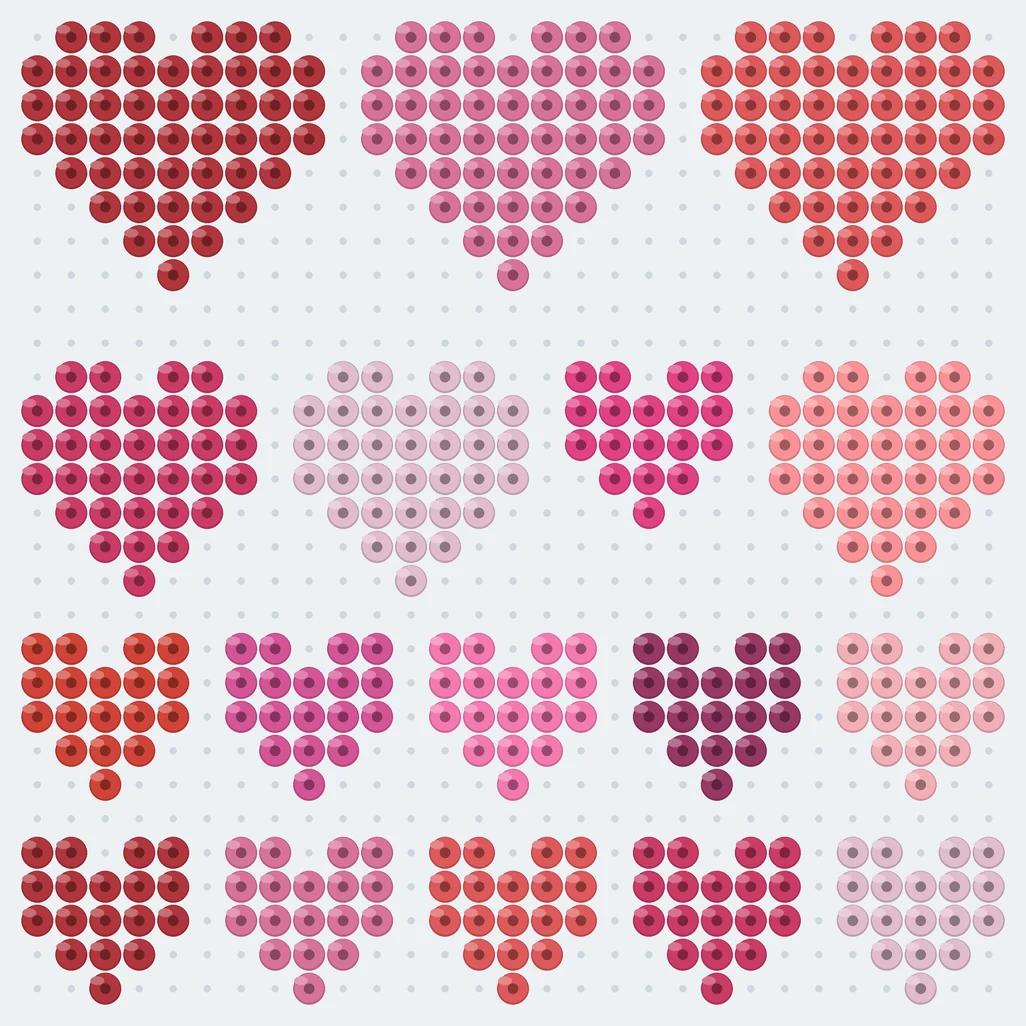
The board above holds 17 hearts in three sizes:
| Heart | Size in beads | Beads each | Width with 5 mm beads |
|---|---|---|---|
| Large | 9 wide × 8 tall | 49 | 4.5 cm (1.8 in) |
| Medium | 7 × 7 | 34 | 3.5 cm (1.4 in) |
| Small | 5 × 5 | 18 | 2.5 cm (1 in) |
Together they take 447 beads, about half of the board's 841 pegs. The secret is the gap. Leave at least one empty peg between hearts, and each one irons as a separate piece.
The smallest heart is easy to memorize. Row by row from the top: 2 beads, an empty peg, 2 beads; then 5; then 5; then 3; then 1.
One batch covers class valentines, party favors, card toppers or a garland.
How do you make a smooth heart on a square grid?
A pegboard is all squares. You can't make a true curve, but you can fool the eye.
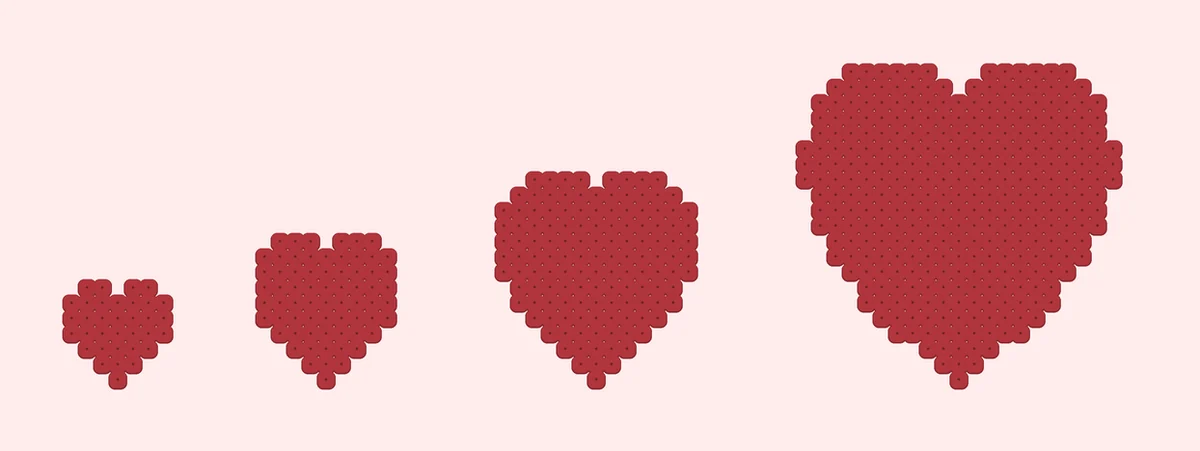
- Go bigger. Each curve gets more steps as the heart grows. At 7 beads wide it reads as pixel art; at 23 the bumps start to look round.
- Use an odd width. An odd number of columns gives a single bead at the point and a notch in the middle of the top. An even width ends in a blunt two-bead tip.
- Make it a little shorter than wide. Ours are 7 × 7, 11 × 10, 15 × 14 and 23 × 21.
- Step the lower sides evenly. Below the widest row, take one bead off each side per row for a clean slope to the point. Save uneven steps for the top bumps, where they read as a curve.
- Outline in a darker shade. A ring of Cherry around a Red heart gives the edge a clear line. One or two White beads near the top of a bump add a glint.
- Or let the board do it. Perler's basic shapes sets include a large heart pegboard (6.75 × 6.12 in) and a small one (3.4 × 2.8 in). Hama's Midi heart boards have 121 pegs (small) and 591 pegs (large).
Big hearts and heart frames
A heart wider than 29 beads won't fit on one square board. You have two options:
- Join square boards. Perler's large square boards interlock, so four of them make a 58 × 58 grid. Clip them together on a flat table before you place a bead, and keep them joined until the piece is ironed.
- Use one big board. Perler's Super-Sized Clear pegboard measures 10.5 × 14 in, wide enough for the 43-bead heart further down.
A big heart doesn't have to be solid. Make it a frame: a border two beads thick and a different color inside, a window for a name, a date or a face.
Ironing is a job for an adult. Perler's heart projects call for a medium iron, ironing paper and small circles for about 10 to 20 seconds per side, until the beads join but their centers stay open. A big heart takes longer, so work across it in sections and lift the paper to check. Iron both sides, then cool it flat under a heavy book.
3D and jointed hearts
Crossed 3D heart
Make two identical hearts, 15 beads wide or more. On the first, leave the center column empty from the notch at the top down to the middle. On the second, leave it empty from the point up to the middle. Iron both lightly so the slots stay open, then slide one into the other at a right angle. Hang it from a thread and it looks like a heart from every side.
For a raised look, stack instead: glue a smaller heart onto a bigger one, then a third on top. Our 3D Perler beads guide covers slots, glue and layers.
Jointed heart
Perler's jointed heart splits a heart into separate segments, linked with six jump rings and hung from an 18 in satin cord. Its pattern sheet shows how the pieces connect. To design your own, cut a heart pattern into bands, add a tab bead at each joint and iron with the tab holes open, so a jump ring fits through.
Heart gifts: keychains, magnets and cards
Hearts are the classic gift for Valentine's Day and Mother's Day. US Mother's Day is the second Sunday in May. UK Mothering Sunday comes earlier: 7 March in 2027.
- Keychains. A 9 × 8 or 11 × 10 heart is a good size. Add a tab bead above one bump for the jump ring and keep its hole open when you iron. Our Perler bead keychain guide covers rings and pliers. A heart split down the middle makes two best-friend keychains.
- Magnets. Glue a flat magnet to the back of a well-fused heart. Small magnets are dangerous if swallowed, so keep them away from young children.
- Cards. Perler's Valentine hearts card glues a bead border onto the front of a folded 6 × 6 in card, with small hearts centered inside it. Perler warns that the finished card may need extra postage.
- Necklaces. The rainbow heart necklace uses 121 beads on Perler's small heart pegboard, with a ribbon threaded through two beads near the top. Perler pitches it for Valentine's Day or Mother's Day.
- Keepsakes. A heart frame with a portrait inside, below. Our DIY photo gifts guide has more photo ideas.
A heart-framed pet portrait
This is the heart people keep: a border of reds around a small portrait of your dog, your cat or your partner.
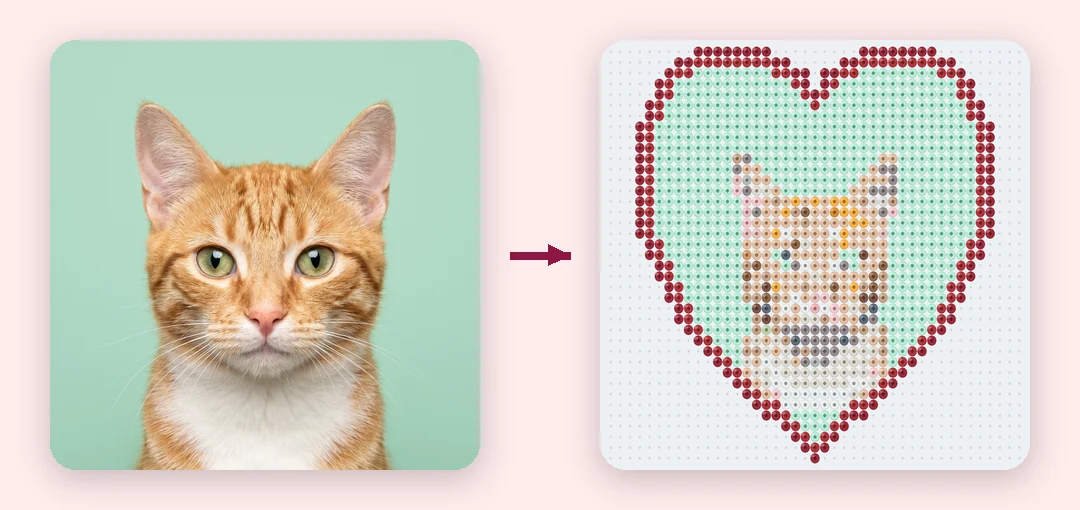
Ours is 43 beads wide and 39 tall: 1,055 beads in 19 colors, about 21.5 × 19.5 cm (8.5 × 7.7 in).
1. Make the portrait first
A portrait from a photo means choosing a few dozen real bead colors out of thousands of shades, then counting each one. BeadPop does that on iPhone. It finds your pet in the photo, removes the background and matches every bead to real colors of the brand you own: Perler, Hama, Artkal, MARD or Nabbi. Set it to one board, 29 × 29, and you get a shopping list with the count and brand code of each color, plus a PDF that prints at real size to slide under a clear pegboard. Don't like a shade? Swap it with color adjust, or touch up single beads. Build mode highlights one color at a time and saves your progress, and your photos stay on your phone. If you only want a plain heart, there's a ready-made one among its templates.
Pick a photo where the face fills the frame, the eyes are in focus and the light is soft daylight.
2. Place it in the heart
A heart is widest near the top. Put the face in the wide upper half and let the chest run down toward the point. At our heart's widest row, the 29-bead portrait leaves 7 beads on each side: 2 of border and 5 of background.
The full square doesn't fit inside the heart, and it doesn't have to. With the background removed, only the pet's outline must sit inside the border. Keep at least one bead of fill between pet and border.
A rough rule: make the heart about one and a half times as wide as the portrait. Plan it on graph paper or a spreadsheet with square cells. Shade the pet's outline, then draw the heart around it.
3. Draw a two-bead border
Outer row in the darkest red, inner row a step lighter: ours uses Cherry (P961) outside and Red (P05) inside. Two rows give the edge weight.
Fill the space between pet and border with one plain color that contrasts with both. We chose Mint (P240): green sits opposite red on the color wheel, and it's nothing like orange fur. For a black dog, try a pale pink fill.
4. Build it on joined boards
Clip four large clear square boards together, 2 × 2, or use one super-sized board. Slide the printed portrait under the clear boards where the face goes; a real-size print lines up with the pegs. Place the border, then the portrait, then the fill. An adult irons it, section by section.
Turn your own photo into a bead pattern
BeadPop turns any photo into a bead pattern with real bead colors and a shopping list.
Which reds and pinks should you use?
Each brand names and numbers its own shades, so pick from the chart of the beads you own:
- Perler: Cherry (P961), Red (P05), Tomato (P211), Hot Coral (P59), Salmon (P204), Raspberry (P88), Magenta (P38), Pink (P83), Rose (P244), Bubblegum (P06), Cotton Candy (P242), Blush (P63), Flamingo (P203) and Light Pink (P79).
- Hama Midi: Burgundy (30), Maroon Red (118), Dark red (22), Red (05), Cherry red (114), Pastel red (44), Claret (29), Fuchsia pink (121), Pink (06), Pastel pink (48), Pastel rose (95), Matt rose (26), Blush (112) and Dark blush (111). The Hama colour chart uses the same numbers for Mini, Midi and Maxi, but the Midi range is the widest.
- Artkal, MARD and others: bigger ranges with their own codes. Artkal lists over 200 colors in its S series alone. Check the brand's chart before you buy.
A few habits help you choose:
- Pair a dark red with a lighter one for borders. Perler Cherry with Red, as in our frame. In Hama, Dark red (22) or Cherry red (114) can play the outline role next to Red (05).
- Test before you commit. A name doesn't tell you everything, and every iron is different. Iron a short strip of each candidate side by side and choose from the ironed strip, in daylight.
- Mix brands with care. Perler and Hama Midi beads are both 5 mm, but test-iron a mix before a big piece. Our Perler bead color chart has a table of the closest Hama, Artkal and MARD matches for common Perler colors.
FAQ
How many beads does a Perler bead heart take?
A 5 × 5 heart takes 18 beads and a 23 × 21 heart takes 309; the sizes in between are listed above. Our 43 × 39 frame with a cat portrait takes 1,055.
What's the easiest heart for kids?
The 5 × 5 heart or a small heart pegboard. Kids place the beads; an adult does the ironing. Loose beads are a choking hazard, so keep them away from children under 3.
Can I use Hama beads for these patterns?
Yes. Hama Midi beads are 5 mm, like Perler, and fit the same 29 × 29 grid. Only the color names and codes change.
How do I hang a bead heart?
Add a tab bead above one bump and put a jump ring through it, or thread a ribbon through two beads near the top, as Perler's rainbow heart necklace does. Iron gently around those beads so their holes stay open.
Turn your own photo into a bead pattern
BeadPop turns any photo into a bead pattern with real bead colors and a shopping list.