Perler Bead Cat Patterns: From Easy to Your Own Cat
A Perler bead cat is one of the most rewarding things you can make with fuse beads. A simple cat face takes one evening, and a portrait of your own cat can hang on the wall for years. This guide starts with three easy designs, then covers the colors that work for each coat, how big your cat should be, and how to turn a photo of your own cat into a pattern you can actually build.
Everything works the same with Hama beads, the brand most people use in the UK and Europe. Standard Perler beads and Hama Midi beads are both 5 mm and fit the same pegboards.
Easy Perler bead cat designs to start with
These three designs were drawn bead by bead with real Perler colors. Each fits easily on one 29 × 29 pegboard.
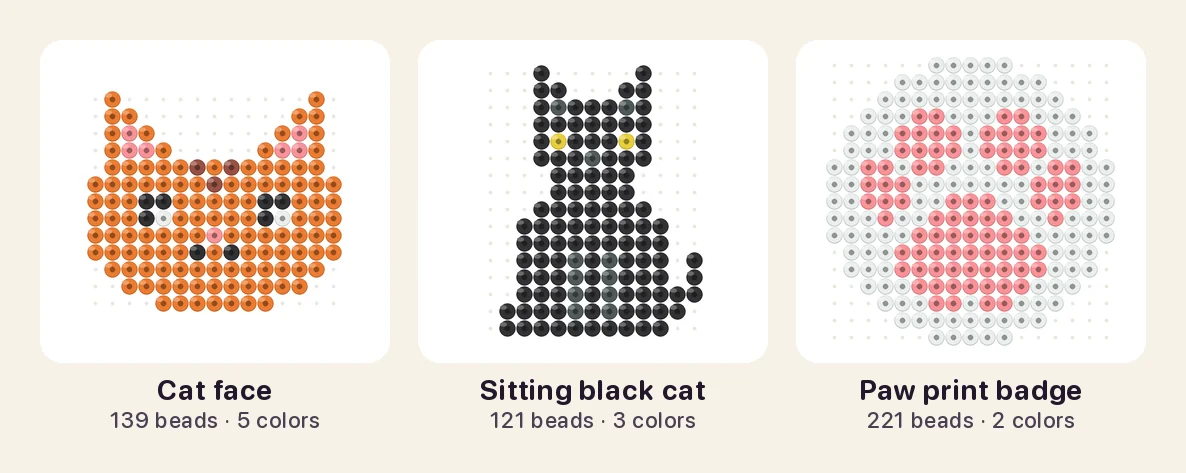
- Cat face (15 × 13 beads). Orange with a few rust beads for forehead stripes, pink ears and nose, black eyes with one white highlight each. Place the eyes and nose first, then fill the orange around them. That way you never lose count of where the face sits.
- Sitting black cat (13 × 16 beads). Almost all black, with two yellow eyes and charcoal lines that separate the legs from the body. It shows how a few gray beads keep a black shape readable.
- Paw print badge (17 × 17 beads). The toes sit on a white circle for a reason: beads only fuse to the beads they touch on a side. Separate toe "islands" would fall off after ironing. The background holds the whole print together, and it makes a good coaster or magnet.
That connection rule applies to every design you draw. If two parts meet only at a corner, add a bead to join them.
Choosing colors by coat
The coat is where a bead cat starts to look like a specific cat. The chart shows Perler colors that work for the four most common coats.
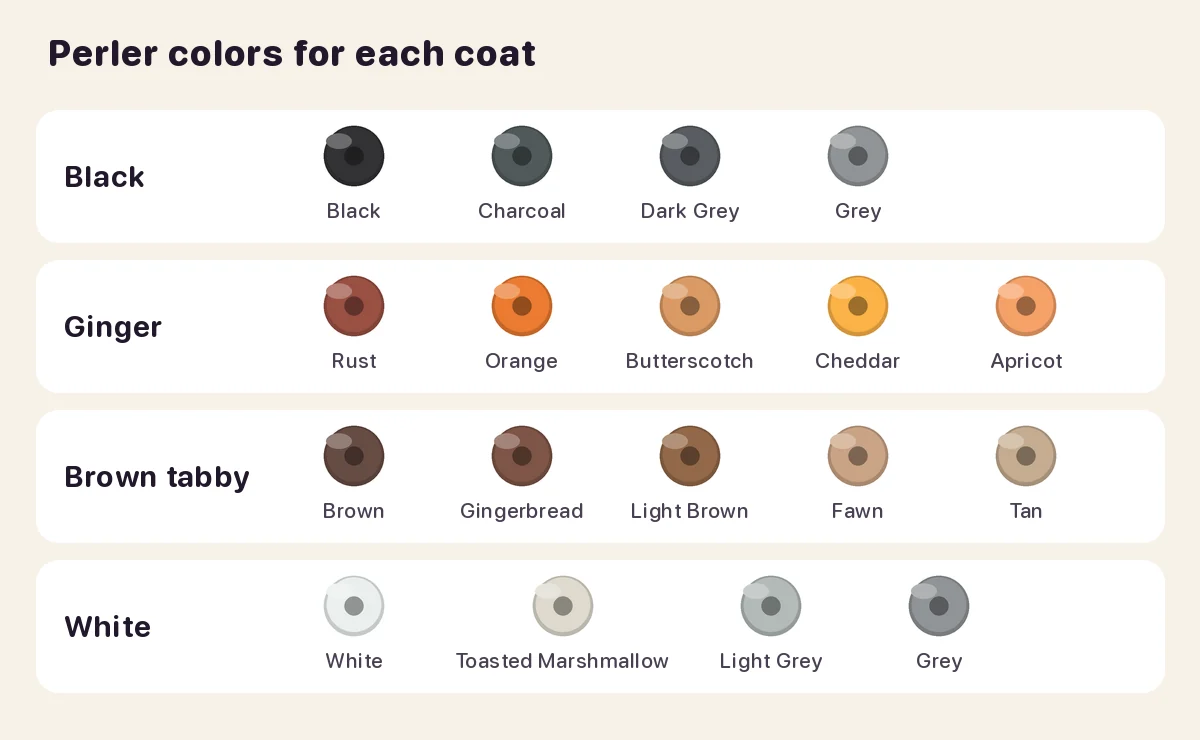
For Hama, Black, Dark Grey and Light Grey cover black and gray cats, Teddybear Brown and Light Brown cover most ginger cats, and Nougat, Tan and Beige cover brown tabbies. Our Perler bead color chart explains how to read color codes and which shades look alike after ironing.
Black cats: highlights that keep the shape
A cat made of pure black beads turns into a silhouette. That can be the look you want, but if you want a face, you need highlights.
- Put Charcoal or Dark Grey where light hits: the top of the head, the rims of the ears, the cheeks and the shoulder.
- Let the eyes do the work. Yellow, green or amber eyes jump out of a black face. Add one white bead as a reflection.
- Keep the background light. A black cat on a dark backing or a black frame disappears.
Ginger and tabby stripes
Ginger cats look best with at least three oranges. Use a mid orange for the main coat, a lighter one like Cheddar or Apricot for the cheeks and chest, and Rust for the stripes.
Stripes are where people overdo it. On one pegboard, two or three stripes on the forehead (the classic "M") are enough. A stripe is at least one bead wide, which is a lot of fur at that scale. On bigger pieces, follow the stripes you see in the photo.
Brown tabbies work the same way with a brown range: Light Brown or Fawn as the base, Brown or Gingerbread for the stripes, Tan for the light areas.
White and calico: contrast with the background
White cats need shadows, or they become a flat white blob. Use Toasted Marshmallow for warm shadows and Light Grey for cool ones, around the eyes, under the chin and along the body.
Contrast matters too. A white cat on white paper or a white wall vanishes. Frame it on a colored backing, or give the outline a ring of light gray.
Calico cats are patches of orange, black and white. Keep each patch as a solid block of color. At bead scale, scattered single beads read as noise, not as a calico coat.
How big should your cat be?
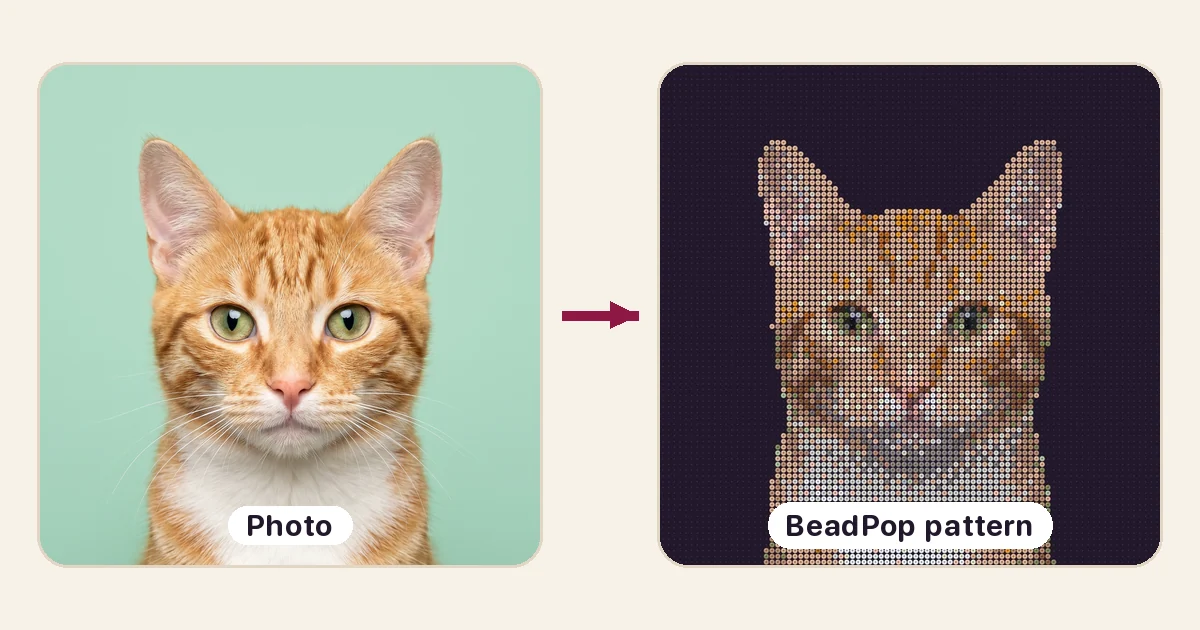
Size decides how much detail fits. The diagram shows the three common sizes at the same scale: a simple cat face on one pegboard, an empty 2 × 2 grid, and a real BeadPop portrait of a ginger cat on 3 × 3 boards.
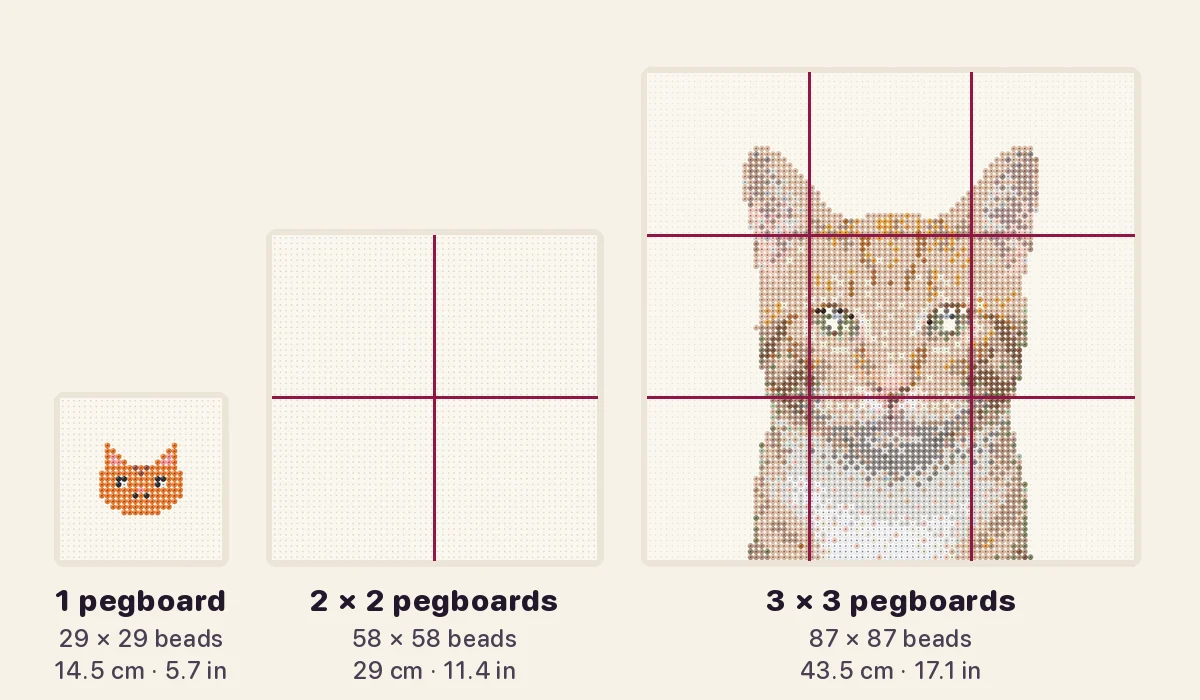
| Size | Beads | Finished size (5 mm beads) | What fits |
|---|---|---|---|
| 1 pegboard | 29 × 29 | about 14.5 cm (5.7 in) | A simplified face, a keychain, a magnet |
| 2 × 2 pegboards | 58 × 58 | about 29 cm (11.4 in) | Head and shoulders with clear markings |
| 3 × 3 pegboards | 87 × 87 | about 43.5 cm (17.1 in) | A portrait with fur texture and eye color |
The ginger cat in the diagram uses 3,199 beads in 23 colors. That's well under the 7,569 pegs of a 3 × 3 grid, because the background is left empty.
Want more detail in less space? Mini beads (about 2.6 mm) fit the same number of beads into roughly half the width. An 87-bead-wide portrait in mini beads is about 22.6 cm (8.9 in) across.
Making a pattern of your own cat
This is the part people search for and then give up on. Here is how to do it by hand, and where an app can save you hours.
The photo that works
- Daylight, no flash. Flash flattens fur and puts glare in the eyes.
- Eye level, face toward the camera. Both eyes visible, ideally looking at you.
- A plain background. A wall, a blanket or a sofa separates from fur far better than a busy room.
- Sharp eyes. People recognize a cat by its eyes and markings, so those must be in focus.
Don't worry about whiskers. They're much thinner than a bead and usually disappear at every size.
Cropping and simplifying
Crop the photo to a square around the head (add the chest for 2 × 2 or 3 × 3). Then shrink it to the number of beads you want across, 29, 58 or 87, in any photo editor, so each pixel becomes one bead.
Next, cut the colors down. Merge pixels that are almost the same, and keep the ones that define the cat: the eye color, the nose, the markings. For one pegboard, six to ten colors are plenty. Clean up stray single beads around the edges, and remove the background so the cat stands on its own.
Matching colors to your bead brand
A color on screen is not a bead. Each brand has its own palette, and the same name rarely means the same shade: Perler's "Orange" and Hama's "Orange" are noticeably different. Match every color to the real palette of the brand you'll buy, then check the actual beads in daylight before you start. Screens and dye batches vary.
Counting beads before you buy
Count the beads of each color in your finished grid. Add a few extra per color, since beads roll away and the odd one comes out misshapen. For a 3 × 3 portrait, this count is the slowest part of the whole job.
BeadPop handles the slow steps for you. It finds the cat in the photo, removes the background, matches every bead to the real palette of your brand (Perler, Hama, Artkal, MARD or Nabbi, mini beads included) and counts every bead per color for the shopping list. You can still change the colors and fix single beads with a pencil, eraser and fill. Your first full pattern is free.
Turn your own photo into a bead pattern
BeadPop turns any photo into a bead pattern with real bead colors and a shopping list.
What to make with it
- Keychain. A one-board face, or a mini bead version for something smaller. Build a ring of beads around one empty peg at the top for the key ring.
- Magnet. Glue a magnet to the back of a simple face or a paw print.
- Framed portrait. A 2 × 2 or 3 × 3 piece looks great in a deep frame or shadow box that keeps the glass off the beads.
Iron both sides of anything that will be handled, and cool it flat under a heavy book. Our guide on how to iron Perler beads covers the details. Got a dog too? See Perler bead dog patterns for paws, bones and dog portraits. Other pets at home? Perler bead animals covers rabbits, birds, turtles and more.
FAQ
What colors do I need for a Perler bead cat?
Plan on three or four shades of the main coat color, plus black for the eyes and nose, white for highlights and a pink for the nose and ears. For ginger cats, for example: Rust, Orange, Cheddar and Apricot, with white for the chest.
How do I make a black cat in beads without losing the shape?
Add Charcoal or Dark Grey highlights where light hits the head, ears and shoulders, give it bright eyes and keep the background light.
How many beads does a cat portrait need?
A simple face like the one above takes 139 beads. A detailed portrait across 3 × 3 pegboards can take several thousand: the ginger cat in this guide uses 3,199 beads in 23 colors.
Can I use Hama beads for these cat patterns?
Yes. Hama Midi beads are the same 5 mm size as standard Perler beads. The color names differ, so match each color to the Hama palette.
Is it hard to make a pattern of my own cat?
Not by hand if you keep it small and simple. Larger portraits take longer, mostly because of color matching and counting. An app like BeadPop does both from a single photo.
Turn your own photo into a bead pattern
BeadPop turns any photo into a bead pattern with real bead colors and a shopping list.