Perler Bead Dog Patterns (and How to Bead Your Own Dog)
A Perler bead dog can be as quick as a bone you finish before dinner or as ambitious as a portrait of your own dog across nine pegboards. This guide covers both. You'll find three quick designs, how to handle coats, ears, eyes and noses, which size to choose, and a step-by-step way to turn a photo of your dog into a pattern you can build.
The same advice works for Hama beads, the brand most people use in the UK and Europe. Standard Perler beads and Hama Midi beads are both 5 mm wide and share the same pegboards.
Quick Perler bead dog designs: bone, paw and head
These designs were drawn bead by bead with real Perler colors, and each fits on one 29 × 29 pegboard.
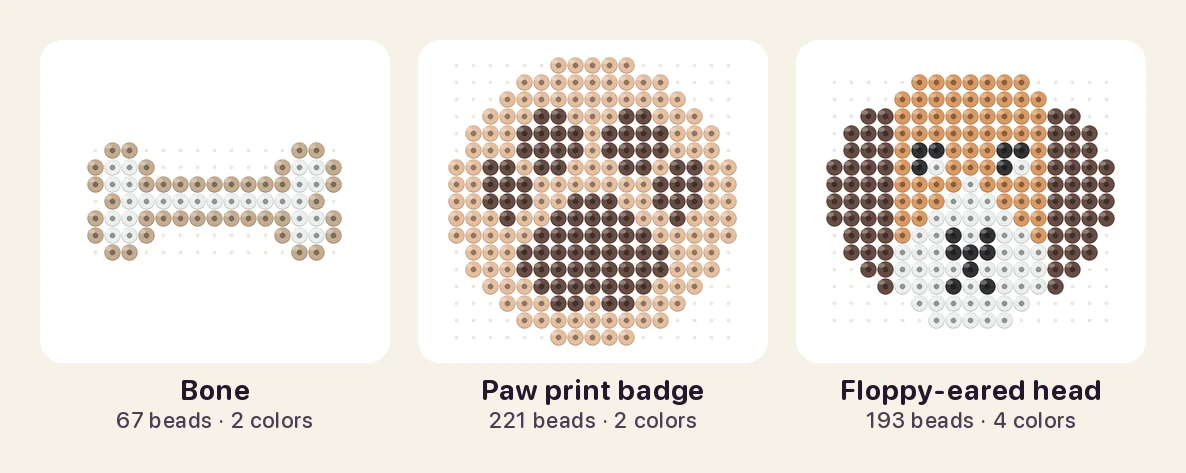
- Bone (15 × 7 beads, 67 beads). White with a tan outline, so it still shows on a light background. It makes a good first project and a good gift-tag shape.
- Paw print badge (17 × 17 beads, 221 beads). The paw sits on a round background because beads only fuse to neighbors that touch on a side. Loose toe "islands" would fall off after ironing. The disc keeps it in one piece and doubles as a coaster.
- Floppy-eared head (17 × 15 beads, 193 beads). Dark brown ears, a butterscotch head and a white muzzle and blaze, in the style of a beagle. It shows the basic dog-face recipe you'll reuse below.
Coats and ears that look great in beads
Dogs vary far more than cats, but most coats fall into a few groups. These Perler colors are a good starting point:
- Golden and cream coats: Butterscotch, Honey, Sand, Tan and Creme. The golden puppy portrait below uses this kind of warm range.
- Black and white coats, like huskies and border collies: Black, Charcoal, Grey, Light Grey and White. Huskies need several grays, not just black and white.
- Chocolate and brown coats: Brown, Cocoa, Gingerbread and Light Brown.
- Fawn short coats, like French bulldogs and pugs: Fawn, Tan and Sand, with Black or Charcoal for the mask.
For Hama, Teddybear Brown, Beige, Tan and Nougat cover the golden-to-brown range, and Black, Dark Grey, Light Grey and White cover the rest.
Ears give a dog its character, so make them readable:
- Floppy ears look best one shade darker than the head. The darker color reads as the shadow under the ear and separates it from the face.
- Upright ears, like a husky's or a French bulldog's, need a lighter inner color. A pinkish or pale tone inside a dark rim makes the triangle obvious.
- Long fur looks softer with an uneven outline. Let the edge step in and out by a bead here and there instead of drawing a perfect curve.
Brindle and merle coats are hard at small sizes. Simplify them to two or three tones and keep the pattern bold, or move up to a bigger board.
Eyes and nose: the few beads that make the face
On a small design, the whole face comes down to a handful of beads. Get these right and the rest can stay simple.
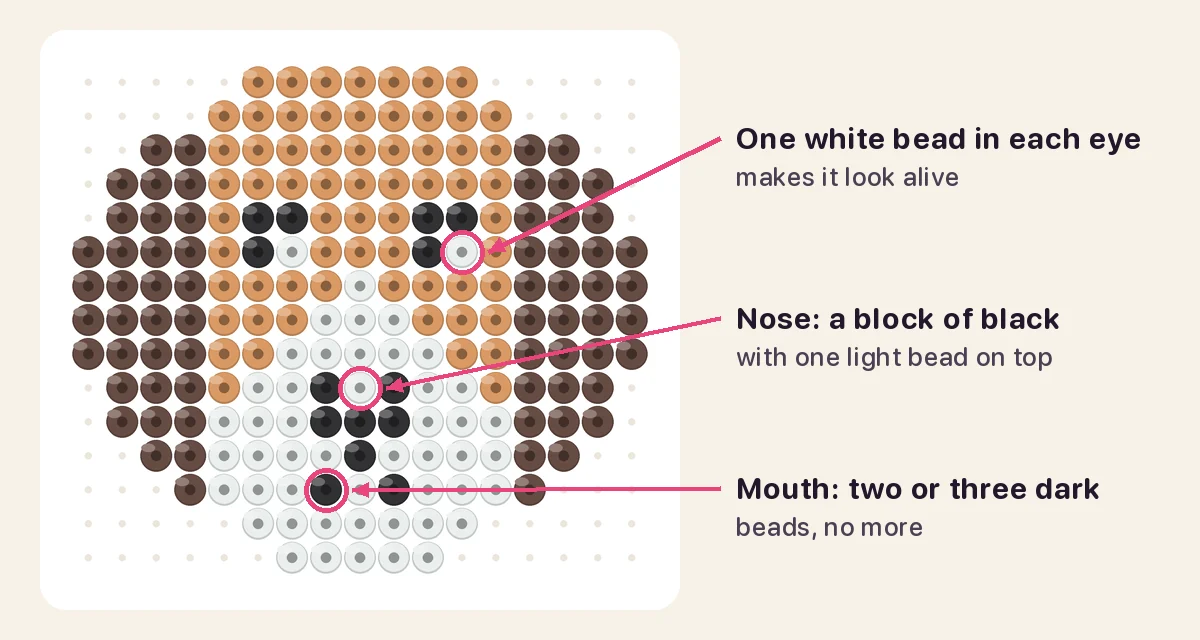
- Eyes. On one pegboard, an eye is a single bead or a 2 × 2 block. Add one white bead as a reflection, on the same side in both eyes. That tiny highlight is what makes a bead dog look alive. For blue-eyed dogs, a light blue eye inside a dark rim works well.
- Nose. A small block of black with one lighter bead on top for shine. Center it carefully: count beads from the middle line so both sides of the face match.
- Mouth. Two or three dark beads are enough. A pink tongue, two or three beads hanging below the mouth, turns a neutral face into a happy one.
Size and detail: 1 board vs 2×2 vs 3×3
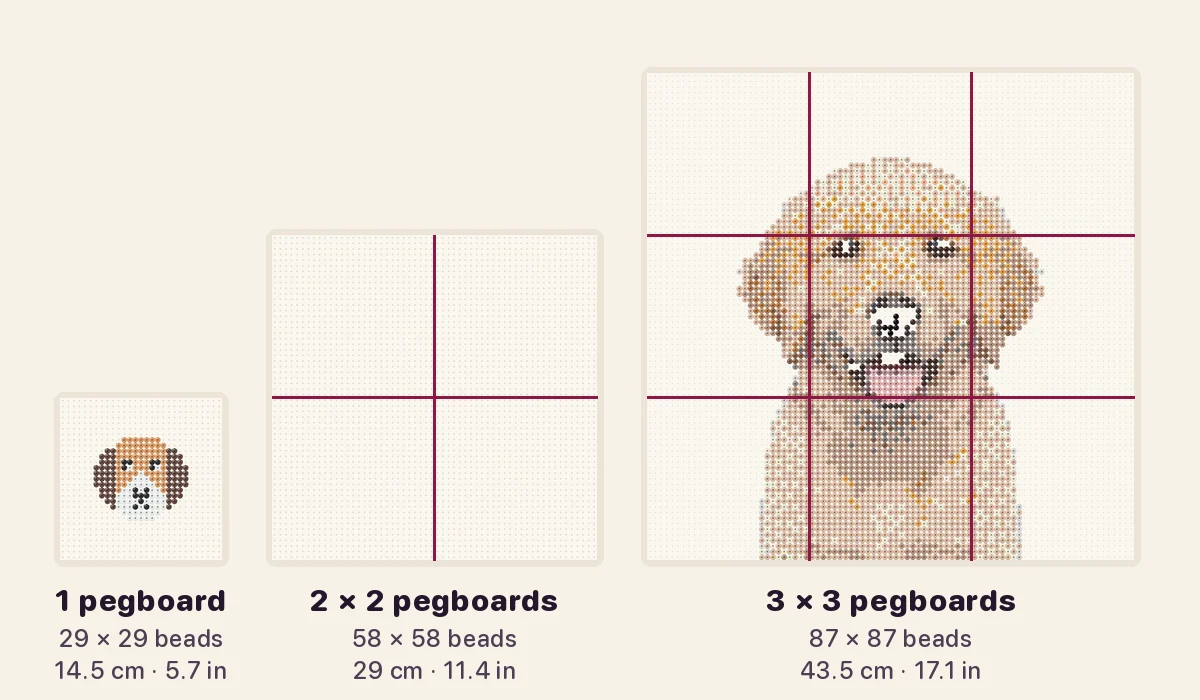
The size you choose decides how much of your dog fits into the pattern. The diagram shows the three common sizes at the same scale, with a simple head on one board and a real BeadPop portrait of a golden puppy on 3 × 3 boards.
| Size | Beads | Finished size (5 mm beads) | What fits |
|---|---|---|---|
| 1 pegboard | 29 × 29 | about 14.5 cm (5.7 in) | A simple head, a keychain, an ornament |
| 2 × 2 pegboards | 58 × 58 | about 29 cm (11.4 in) | Head and shoulders with markings |
| 3 × 3 pegboards | 87 × 87 | about 43.5 cm (17.1 in) | A portrait with fur texture |
The golden puppy uses 3,065 beads in 19 colors. A husky portrait at the same size uses 2,837 beads, and a French bulldog 2,494, because more of the board stays empty around them.
From photo to pattern: bead your own dog
Here's how to go from a favorite photo to a pattern you can build, by hand or with an app.
The photo that works
- Daylight, no flash. Flash flattens fur and adds glare to the eyes.
- Eye level, face toward the camera. Get down to your dog's height. Both eyes visible, mouth open if that's how you know them.
- Sharp eyes. Focus on the eyes. Blur elsewhere matters much less.
- One dog per photo. Two dogs share the beads and both lose detail.
Background and contrast
A plain background makes the dog easy to separate: a wall, a blanket, a clean floor. Grass, leaves and busy rooms leave stray colors around the ears.
Think about contrast for the finished piece too. A black dog needs a light backing, and a white dog needs a colored one or a soft gray outline. Otherwise the edges vanish.
Colors from the brand you own
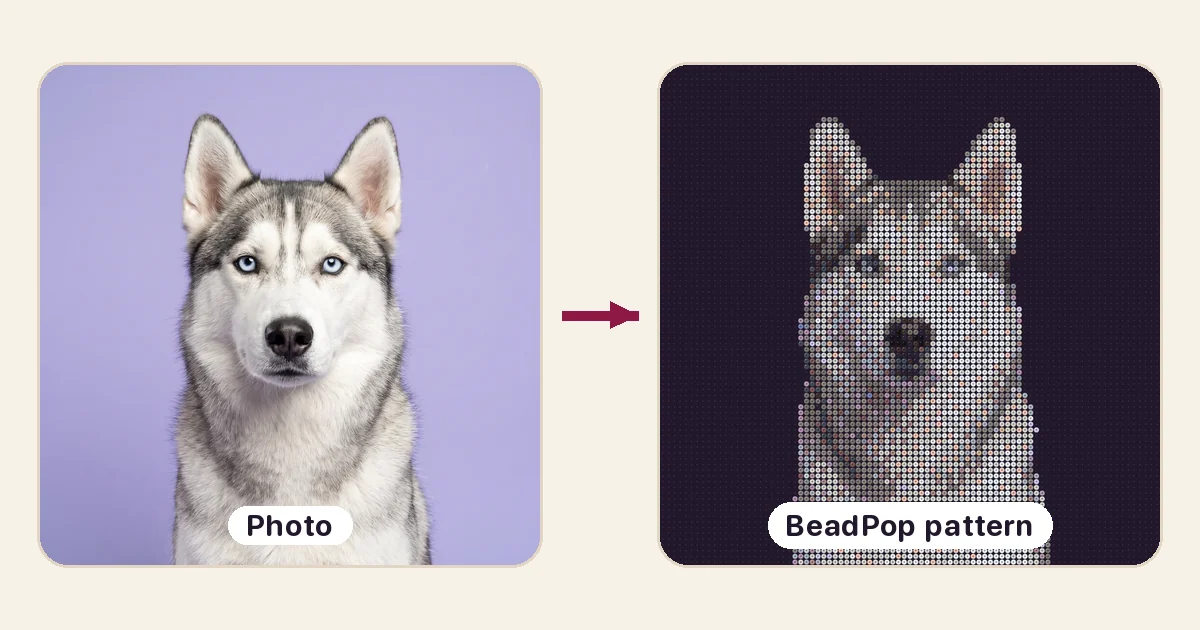
Crop the photo to a square around the head, shrink it to 29, 58 or 87 pixels wide so each pixel is a bead, then reduce the colors. Keep the colors that define your dog (eye color, nose, markings) and merge the rest.
Then match each color to the real palette of the brand you'll buy. Brands don't share colors: a "Tan" in one brand is a different bead in another. Check your actual beads in daylight before you start, since screens and dye batches vary.
Shopping list and building one color at a time
Count the beads of each color and add a few extra. Then build one color at a time, starting with the biggest areas. It's faster than following the picture row by row, and you knock over fewer beads.
On a 3 × 3 portrait, the real problem is losing your place: you stop for dinner and come back to thousands of identical pegs. That's where BeadPop helps most. It turns your photo into a pattern with the background removed and every bead matched to the real colors of your brand (Perler, Hama, Artkal, MARD or Nabbi). The shopping list gives the exact count per color. Build mode highlights one color at a time, you tap each bead as you place it, and your progress is saved, so you always know where you stopped.
Turn your own photo into a bead pattern
BeadPop turns any photo into a bead pattern with real bead colors and a shopping list.
When the beads are all in place, iron both sides and cool the piece flat under a heavy book. Big pieces are easier with Perler's tape method, explained in our guide on how to iron Perler beads.
What to make: keychain, magnet, ornament, memorial
- Keychain. A one-board head or a paw. Build a ring of beads around an empty peg at the top for the key ring.
- Magnet. Glue a magnet to the back of a head or bone.
- Ornament. A one-board head of your dog is a lovely tree ornament. Our guide to Christmas Perler beads shows how to make it hang well.
- Memorial. A bead portrait from a favorite photo is a gentle way to remember a dog who has died. See our DIY pet memorial ideas for that and other keepsakes.
Have a cat in the house too? Our Perler bead cat patterns cover coats from black to calico.
FAQ
What's an easy Perler bead dog for beginners?
A bone or a paw print. Both use two colors and fit on one pegboard. The bone takes 67 beads, so it's done in minutes.
How do you make a dog's face in Perler beads?
Start with the eyes and nose, then fill around them. Use one white highlight bead in each eye, a black nose with one lighter bead on top and two or three dark beads for the mouth.
How many beads do I need for a dog portrait?
A simple head on one pegboard takes around 200 beads. A detailed portrait across 3 × 3 pegboards takes a few thousand: the golden puppy in this guide uses 3,065 beads in 19 colors.
Can I use Hama beads for dog patterns?
Yes. Hama Midi beads are 5 mm, the same size as standard Perler beads. Match colors to the Hama palette, since the names differ.
What size should a Perler bead dog portrait be?
One pegboard for keychains and ornaments, 2 × 2 for a recognizable head and shoulders, 3 × 3 for a detailed framed portrait.
Turn your own photo into a bead pattern
BeadPop turns any photo into a bead pattern with real bead colors and a shopping list.