Perler Bead Star Patterns: Flat, 3D and Tree Toppers
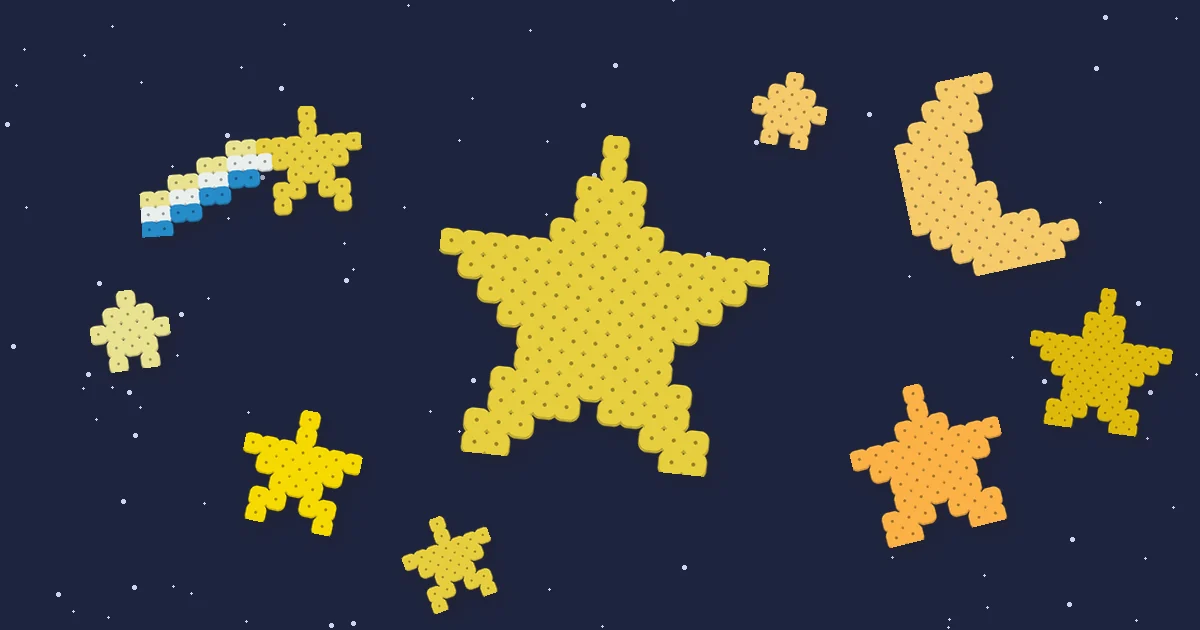
A Perler bead star is one of the first shapes everyone tries, and one of the easiest to get wrong. Five points don't sit neatly on a square grid, so stars come out lopsided or lose a tip. Here are six five-point patterns from 5 to 15 beads wide, the rules behind them, and December projects: ornaments, a 3D star, a tree topper and a star around your pet's face. It all works the same with Hama beads, the UK favorite, and with Artkal.
How do you make a Perler bead star on a square grid?
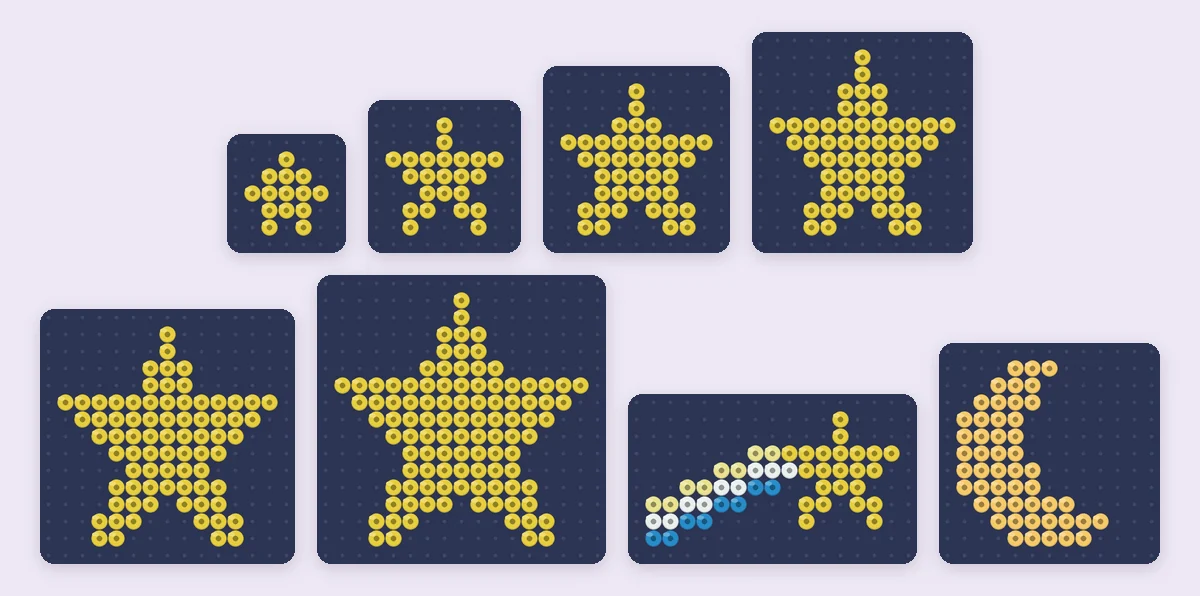
A five-point star is all slanted lines, and a pegboard has none, so you fake it with steps. Every star above follows five rules:
- Pick an odd width. It leaves one center column, so both halves can match.
- Make the top point one column. One bead wide, two beads tall from 7 wide up. Below it, widen by one bead on each side every two rows or so.
- Put the arms on one full-width row about a third of the way down. On a geometric star the arm tips sit at about 38% of the height.
- Narrow the body. Take one bead off each side per row until the star is about half its full width. That's the waist.
- Splay the legs. Leave the center bead empty and let each leg step outward, ending in feet one or two beads wide with a gap between them.
The 11-bead star reads like this, row by row from the top: 1, 1, 3, 3, 11, 9, 7, 5, 5, then two legs of 3 beads and two feet of 2.
Before you iron, check that every bead touches a neighbor side by side, not only at a corner. Corner-only beads barely fuse and snap off. All eight patterns above pass that test, tips and feet included.
| Width | Beads | Finished size (5 mm beads) | Good for |
|---|---|---|---|
| 5 | 14 | 2.5 cm (1 in) | Tiny charms, card toppers |
| 7 | 23 | 3.5 cm (1.4 in) | Earrings, zipper pulls, favors |
| 9 | 41 | 4.5 cm (1.8 in) | Keychains, magnets |
| 11 | 55 | 5.5 cm (2.2 in) | Ornaments, gift tags |
| 13 | 76 | 6.5 cm (2.6 in) | Ornaments, window stars |
| 15 | 102 | 7.5 cm (3 in) | Mobiles, a topper for a small tree |
These stars are as tall as they are wide. A geometric star is about 5% wider than tall, but nobody notices at this size. For a bigger star, use the same rules: one that fills a large square board is 29 beads wide, about 14.5 cm (5.7 in).
To hang a star, iron the top bead lightly so its hole stays open, then thread fishing line or ribbon through it. Our Christmas Perler beads guide shows other ways to hang ornaments.
Small stars for keychains, earrings and favors
- Earrings. A 7-bead star is 3.5 cm in regular beads, a bold dangle, and under 2 cm in mini beads (about 2.6 mm). Our Perler bead earrings guide covers hooks and jump rings.
- Keychains. Use 9 or 11 beads and iron both sides well. Put the ring through a bead in the three-wide part under the tip: a single-bead point is the weakest spot on a star.
- Party favors and class gifts. Thirty 7-bead stars need 690 beads, so one 1,000-bead bag covers them.
- Gift tags and card toppers. Tie an 11-bead star to a ribbon, or glue a 5-bead star to a card.
Kids can fill a small star in one sitting while an adult does the ironing.
Do star pegboards make five-point stars?
No, and that surprises people. Perler's and Hama's star pegboards have six points. Perler's small star is 3.5 × 4 in and its large star 5.25 × 6 in. Hama makes a Midi small star with 181 pegs, a large star with 541 pegs and a Maxi star with 121 pegs for its 10 mm beads, aimed at kids from age 3. Hama's star boards also set the pegs in offset rows, like a honeycomb, so a square-grid pattern won't line up.
Star boards are still great for kids: the outline is done and the points come out even. Fill one in white and pale blue for a snowflake. For a five-point star, or any other size, use a large square board; every pattern above fits on one. Our pegboard guide compares board types.
Shooting stars, moons and night-sky designs
The shooting star in the gallery is the 7-bead star in Yellow with a trail of three diagonal stripes: Pastel Yellow, White and Light Blue. That's 48 beads on a 15 × 8 grid. The stripes step down two beads at a time, so every bead touches the next side by side and the trail stays on. The crescent moon is 11 × 11, 50 beads of Rich Butter.
Put them together:
- A moon and star wall hanging. Perler's moon and star wall hanging hangs strings of small stars under a moon. Embroidery thread runs through open bead holes, with the ends glued to the back.
- A glow-in-the-dark mobile. Perler's star mobile hangs glow-bead stars on clear filament from a bead ring.
- A night-sky panel. Fill a square board in Midnight or another dark blue, add the moon and scatter single White beads as faraway stars.
How do you make a 3D star or a tree topper?
No app needed here: it's all about how flat pieces join. Our 3D Perler beads guide covers the three ways.
Perler's slot-together 3D star
Perler's 3D star is two six-point stars made on the small star board. Each has a slot. You hold them at right angles, line up the slots and slide one into the other. No glue. Its bead list adds up to 328 beads in eight colors.
Perler warns against over-ironing: beads that close up make the pieces harder to put together. Stop while the holes are still open, and use one to hang the star in a window on fishing line.
Five-point stars are harder to slot. The slot runs along the center column, which is where the top point lives, so the tip would go. Layer them instead.
A layered star tree topper
Perler's star tree topper is fused layers glued together with craft glue. A 24 in length of craft wire, coiled at one end with pliers, goes through the center, bends down the back and is glued there. The rest wraps around the top branch. A five-point version:
- Build a big star that fills a large square board, 29 beads wide, in a deep gold.
- Build the 15-bead star in a lighter yellow.
- Iron both sides of each and cool them flat under a book.
- Glue the small star centered on the big one, points lined up. Add the 7-bead star on top for a third layer.
- Attach the wire the way Perler does, then wrap it around the top branch.
Which yellows and golds look best after ironing?
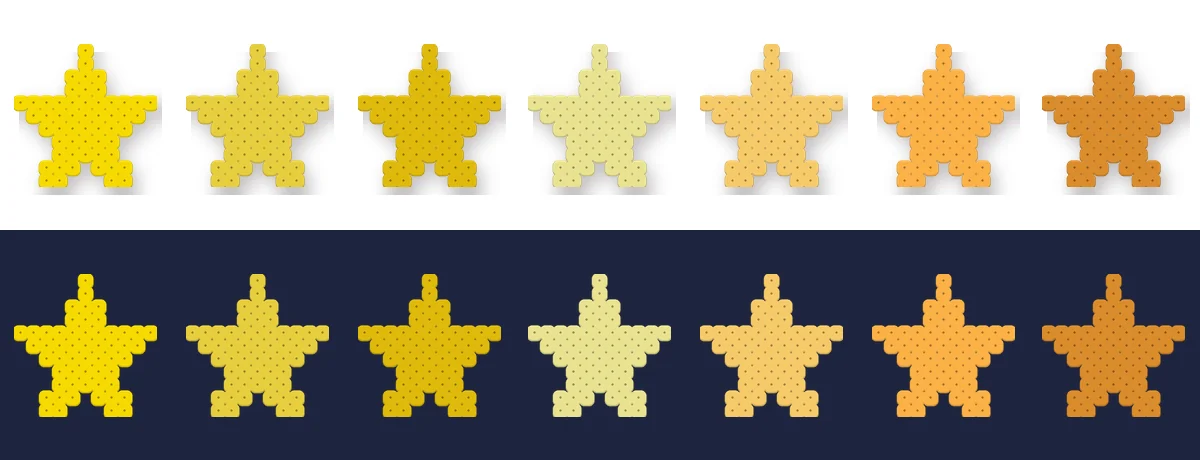
A star is usually one color, so the yellow is the whole design, and the background changes it:
- On dark backgrounds like a green tree, navy felt or a window at night, the light yellows glow. Lemon, Yellow and even Pastel Yellow pop.
- On white or cream walls, Pastel Yellow almost disappears. Pick a deeper gold like Sunflower, Cheddar or Honey, or outline a pale star with one of them.
- For gold, Cheddar and Honey read warm and rich; Rich Butter is softer and suits moons.
- Two tones. A Cheddar edge around a Yellow star looks like a gold rim. The star frame below uses that trick.
Perler has more yellows than these seven. On Hama, try Yellow (03), Light Yellow (103), Pastel Yellow (43) and Gold (61). Screens never show bead colors exactly, so test a few loose beads on your real background before you buy a bag.
A star-framed portrait of your pet
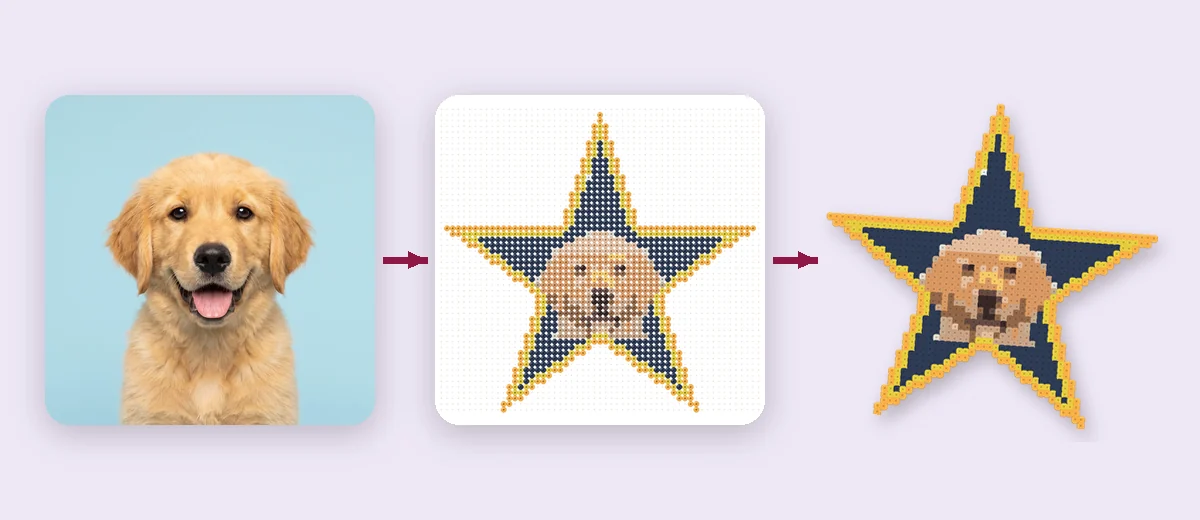
This is the star no one else will have: your dog or cat inside a big gold star. Ours has a Cheddar edge, a Yellow border inside it, a Midnight field with a few White beads as tiny stars, and the puppy's face, 23 beads across, in the middle. The pattern is 57 × 54 beads, 1,005 beads in 13 colors. It fits a block of four large square boards (2 × 2) and comes out about 28 cm (11 in) wide.
- The face comes from a photo. BeadPop turns a pet photo into a bead pattern on iPhone, in the real colors of your brand (Perler, Hama, Artkal or MARD), so the face and the frame share one palette. Set the width to about 23 beads. It takes out the background, gives you the exact count of each color, and prints the pattern at real size to slide under a clear pegboard.
- The star is drawn by hand. BeadPop doesn't make the frame. On graph paper, mark five points: the top in the center column, the two arm tips on a row about 38% of the way down, and the two feet on the bottom row, each about a fifth of the width in from the sides. Join each point to the two across from it, as when you draw a star without lifting the pen. The outline of that drawing is your star. Fill every square the shape covers by more than half, and mirror the left half onto the right.
- Fill from the edge in. Edge first, then the border, then the field around the face. Count the frame beads yourself; the app's counts cover the face only.
Join the four boards, iron one area at a time and cool the piece under a heavy book. Pick a photo where the face fills the frame and the eyes are sharp.
Turn your own photo into a bead pattern
BeadPop turns any photo into a bead pattern with real bead colors and a shopping list.
Ironing stars without losing the points
Perler's star projects all use the same method: medium heat, ironing paper, small circles, about 10 to 20 seconds per side, then flip and repeat. Stop while the beads still have open centers. Single-bead tips heat faster than the body, so lift the paper early to check them. Cool every star flat under a book.
An adult handles the iron, and loose beads are a choking hazard for children under 3. Perler lists its pegboards for ages 6 and up, Hama its Midi star boards from 5.
FAQ
How many beads are in a Perler bead star?
Ours use 14 beads at 5 wide, 23 at 7, 41 at 9, 55 at 11, 76 at 13 and 102 at 15.
Can you make a five-point star on a star pegboard?
Not on Perler's or Hama's: their star boards have six points. Use a square board.
How do you hang a Perler bead star?
Thread fishing line, ribbon or a jump ring through a bead whose hole stayed open, usually the top point. For keychains, use a bead just under the tip.
Can you make these stars with Hama beads?
Yes. Hama Midi beads are 5 mm and fit the same 29 × 29 square boards, so every pattern here works.
Turn your own photo into a bead pattern
BeadPop turns any photo into a bead pattern with real bead colors and a shopping list.