Perler Bead Animals: Patterns Beyond Cats and Dogs
Perler bead animals are the quickest way to make something that looks alive with a pegboard, a bag of beads and an iron. Cats and dogs already have their own guides, our cat patterns and dog patterns. This one covers everyone else, from bunnies and parrots to turtles and garden bugs: ten easy designs with bead counts, color tips for fur, feathers and scales, and how to turn a photo of your own pet into a pattern. Everything works the same with Hama beads, if you're in the UK.
Easy Perler bead animals for one pegboard
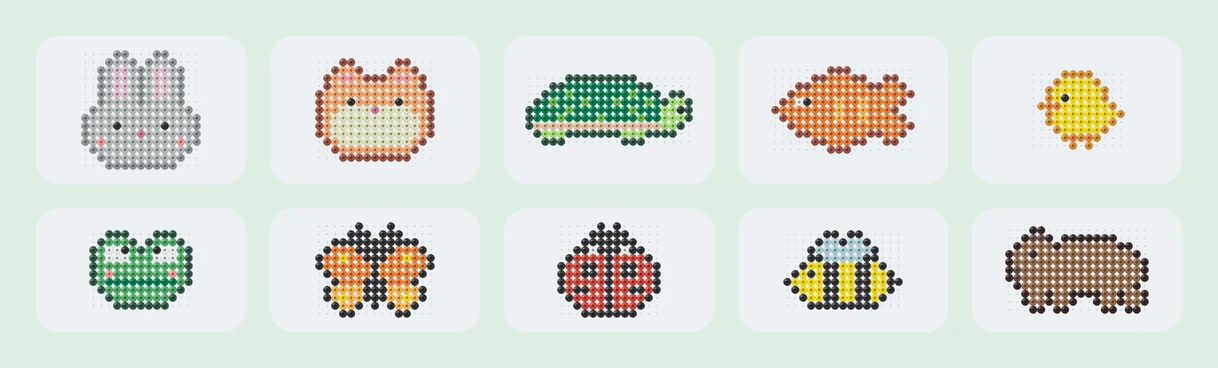
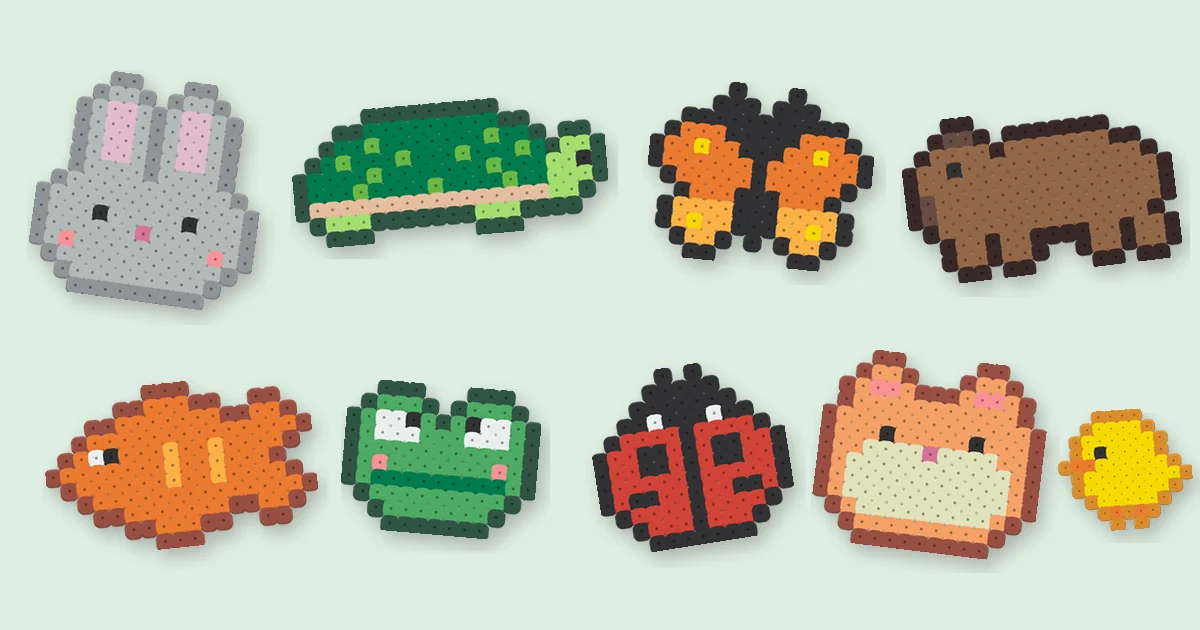
All ten designs fit on one large square pegboard, which has 29 pegs on each side. Sizes include the outline.
| Animal | Size (beads) | Beads | Main colors |
|---|---|---|---|
| Bunny | 15 × 15 | 173 | Light grey, pink ears, grey outline |
| Hamster | 15 × 13 | 161 | Peach, cream belly, brown outline |
| Turtle | 21 × 9 | 145 | Two greens, light green head, tan belly |
| Goldfish | 18 × 11 | 132 | Orange, light orange fins, rust outline |
| Chick | 12 × 10 | 69 | Yellow, orange beak |
| Frog | 13 × 10 | 108 | Green, white eyes, dark green outline |
| Butterfly | 15 × 12 | 125 | Orange wings, yellow dots, black body |
| Ladybug | 13 × 12 | 113 | Red, black head and spots |
| Bee | 15 × 10 | 101 | Yellow and black stripes, pale blue wings |
| Capybara | 18 × 11 | 153 | Brown, dark brown outline |
With standard 5 mm beads, the 15-bead bunny comes out about 7.5 cm (3 inches) across. All ten together use 1,280 beads.
Three things make these designs work:
- A one-bead dark outline. It separates the animal from the background and hides small wobbles in the shape.
- One feature that says the animal. Long ears for the bunny, a shell for the turtle, stripes for the bee.
- Few colors. Most of these use four or five. A small piece with ten colors turns into noise.
Small designs can share a board. The chick (12 beads wide) and the bunny (15 wide) fit side by side with an empty peg between them, and they come off as two separate pieces. Perler also sells shaped pegboards: its Pampered Pets project builds puppies, a cat and a puffed-up fish on fish, kitty and puppy boards.
Small pets: rabbits, hamsters and guinea pigs
Small pets are round and soft, so they forgive simple shapes.
- Rabbits. The ears do all the work. Upright ears say "bunny" from across the room; for a lop, drop the ears down the sides of the head. Fill the inside of each ear with Light Pink (P79), then add a pink nose and two black eyes. A Dutch rabbit is a classic: dark ears, cheeks and back half, with a white blaze and front.
- Hamsters. Draw a wide oval with two tiny ears. A cream belly and full cheeks make it a hamster rather than a mouse. Butterscotch (P90) or Apricot (P213) with Creme (P02) gives you a golden hamster.
- Guinea pigs. Make them longer than tall, with no tail and small petal-shaped ears. Patches are their charm: blocks of White, Light Brown (P21) and Black give you a tricolor in a few dozen beads.
Birds and parrots
Birds are easier than they look, because most of them are blocks of solid color.
- Chicks and ducklings. Yellow, an orange beak and a black eye. At 69 beads, the chick is the fastest design in this guide.
- Owls. A rounded body, two big eye circles in White with Black centers, and an orange beak. The eyes carry the whole design.
- Penguins. Black back, White front, orange feet and beak.
- Parrots. Bright plumage is a gift for beads. A sun conure is Yellow, Cheddar (P57) and Orange on the body, with green wings and a grey beak.
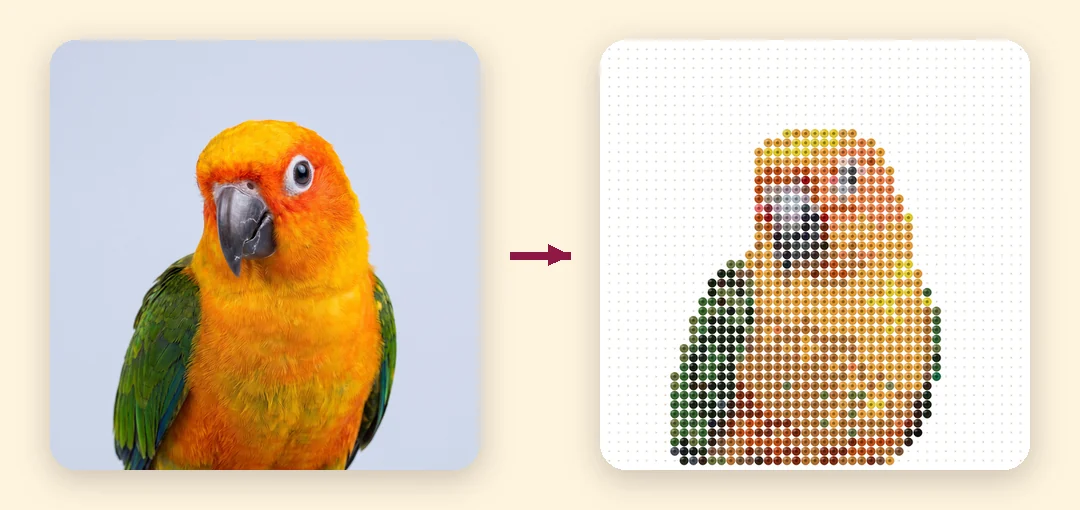
The yellows and oranges hold the shape, and the green wing gets several shades, so it doesn't look flat. The grey beak and white eye ring are only a few beads, but they make it a parrot. Budgies are trickier: their wavy wing bars are thinner than a bead, so draw them as alternating rows of black and yellow instead.
Turtles, fish and sea animals
- Turtles. A dome-shaped shell in two greens, light green head and feet, and a thin tan line where the belly shows. Lighter spots of Kiwi Lime (P61) on the shell add texture. At 21 × 9 beads, the turtle is long and low, a good shape for a bookmark.
- Goldfish and clownfish. An orange body, lighter Cheddar fins and a darker Rust (P20) outline. For a clownfish, add two White bands outlined in Black.
- Axolotls. A Light Pink or Flamingo (P203) body, darker pink gills fanning out from the head, and two black eyes. One dark row makes the wide smile.
- Jellyfish and octopus. Translucent beads make a jellyfish glow in a sunny window. An octopus is a dome plus eight short legs.
Want more detail at the same size? Mini beads are about half the width of standard ones. Perler's mini bead peacock, elephant and turtle uses four mini pegboards and a pair of tweezers to pack a lot of detail into a small piece.
Woodland and wild animals
- Fox. An orange body, White chest and tail tip, Black legs and ear tips.
- Hedgehog. A brown spiky back (a zigzag edge does it) over a Tan face, with a black nose.
- Capybara. One brown block with short legs, a blunt nose and a tiny ear. It's one of the simplest wild animals to bead; the one on our cover uses just two browns.
- Bears and moose. Mostly browns. Perler's Alaskan Animals project, with a grizzly, a moose, a sled dog and a bald eagle, uses 650 Brown and 350 Light Brown beads out of 1,157. Expect to go through browns fast.
- Pandas and zebras. Only Black and White, and they look striking.
Garden bugs belong here too. A butterfly is symmetrical: build one wing, then mirror it peg by peg. A ladybug is red with black spots and a black head. A bee is yellow and black stripes with pale wings; make each stripe at least two beads thick, or it blurs.
How do you pick colors for fur, feathers and scales?
Use three steps of one color instead of a single flat fill: a base, a highlight and a shadow, plus an outline.
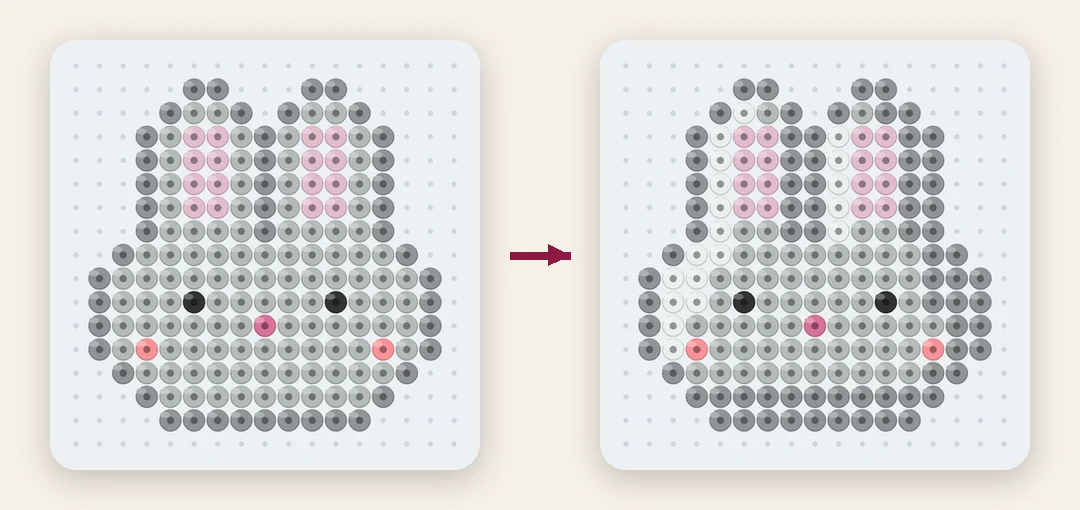
The flat bunny on the left uses Light Grey (P181) with a Grey (P17) outline. The shaded one adds White (P01) along the left edge and ears, as if light came from the upper left, and moves Grey onto the right side and chin. Same shape, same number of beads, but now it looks round. With Hama beads, 70 Light Grey, 17 Grey and 01 White give you the same three steps.
By material:
- Fur. Pick neighbors on the brown or grey ladder: Sand (P98), Tan (P35), Fawn (P205) and Light Brown for a golden coat; Light Grey, Pewter (P206) and Grey for a grey one. Shadows go under the chin and belly and on the side away from the light.
- Feathers. Keep the bright colors flat and big. Add a darker shade only where two areas meet, like a wing over the body.
- Scales and shells. A checker of two close greens (Green P80 and Kiwi Lime), or of Orange and Cheddar, suggests scales without drawing each one.
- Outlines. Black suits bugs and cartoon animals. For furry ones, an outline one step darker than the body (Grey on a light grey bunny, Rust on a goldfish) looks softer.
- Eyes. One Black bead is enough on small pieces. On bigger ones, add a single White bead in the corner of the eye, and the face comes alive.
Can you make a pattern of your own pet?
Yes. By hand, it takes five steps:
- Crop the photo tight around the animal.
- Shrink it to your grid in a photo editor, for example 29 pixels wide for one board.
- Cut the colors down to six to ten.
- Match each color to a real bead on your brand's color chart.
- Count the beads of each color before you buy.
Steps 3 to 5 are the slow ones, and one miscount means a trip back to the store.
The photo that works
- Get down to their level. Shoot a rabbit or guinea pig from the floor, a bird on its perch and a turtle from slightly above.
- Use daylight near a window, without flash. Flash flattens fur and puts white dots in the eyes.
- Pick a plain background that contrasts with the animal: a light wall behind a dark rabbit, a dark towel under a white hamster.
- Make it sharp. Small pets move, so take a burst and keep the frame with crisp eyes.
- Show the markings that make your pet yours, like the patch over one eye or the stripe down the back.
Size and detail
Size decides how much of your pet survives. One 29 × 29 board, about 14.5 cm (5.7 inches) across, gives you a cute icon: the shape, the main colors and the eyes. A 2 × 2 grid of boards (58 × 58 beads) keeps face markings and a few fur shades. Three by three is a real portrait. Round pets and bright birds look good on one board; a pet with fine markings needs at least 2 × 2.
This is where BeadPop saves the slow steps. On iPhone, it finds the animal in your photo, removes the background and matches every bead to the real colors of the brand you own: Perler, Hama, Artkal, MARD or Nabbi. You get a shopping list with the exact count of each color and its code, and a PDF that prints at real size to slide under a clear pegboard. If a shade isn't in your box, swap it with color adjust, and touch up single beads by hand. Build mode highlights one color at a time and saves your progress. Your photos stay on your phone.
Turn your own photo into a bead pattern
BeadPop turns any photo into a bead pattern with real bead colors and a shopping list.
What to make: keychains, magnets and 3D animals
- Keychains and bag charms. The chick, ladybug and bee are the right size. Plan the hole before you iron, with one extra bead at the top as a tab for the ring. Our Perler bead keychain guide shows how.
- Magnets. Glue a small magnet to the back of each animal, and you have a fridge zoo. Iron both sides first, so the back is flat.
- Bookmarks. The long, flat turtle and goldfish make natural bookmarks.
- 3D animals. Perler's Alaskan animals stand up thanks to small foot pieces glued to each side of the feet. Bigger builds use flat pieces that slot together at right angles; see our 3D Perler beads guide.
Whatever you make, an adult does the ironing: medium heat, ironing paper on top, small circles, about 10 to 20 seconds per side, as Perler suggests. Keep loose beads away from little ones. In the US, the Consumer Product Safety Commission bans small parts in toys for children under 3 because they are a choking hazard.
FAQ
What are easy Perler bead animals for beginners?
The chick, frog, ladybug and bee. Each uses 69 to 113 beads and four or five colors, with a simple outline, and fits on one board.
How many beads does a small animal need?
The ten designs above use 69 to 173 beads each. A 2 × 2 portrait can take far more, up to 3,364 beads.
Can I use Hama beads for these animal patterns?
Yes. Hama Midi beads are 5 mm, the same size as standard Perler beads, so the patterns and pegboards work the same. Swap each color for the closest Hama shade.
How do I make a Perler bead animal stand up?
Glue small foot pieces to each side of the feet, as Perler does with its Alaskan animals, or design two flat pieces that slot together.
Are Perler bead animals safe for young kids?
Loose beads are a choking hazard, so keep them away from children under 3. Hama recommends its 5 mm Midi beads from age 5 and its big 10 mm Maxi beads from age 3. An adult always does the ironing.
Turn your own photo into a bead pattern
BeadPop turns any photo into a bead pattern with real bead colors and a shopping list.